London’s affordability nightmare
London breaks 14x house price to earnings ratio
 Living in London has become an affordability nightmare, with property prices rising way beyond average affordability levels.
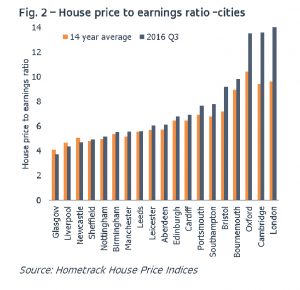
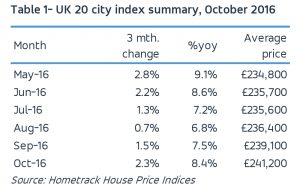
Hometrack’s latest UK Cities House Price Index, covering October 2016, shows that while City level house price growth is holding steady at 8.4 per cent, an 86 per cent uplift in house prices since 2009 has pushed the price to earnings ratio in London over 14x, more than double the UK average of 6.5x.
City level house price inflation is running at 8.4% as the upward momentum in house price continues. Bristol remains the fasting growing city (10.6%) but the rate of growth is slowing. Aberdeen continues to register a year on year price falls (-8.1%).
The impetus for house price growth is shifting from the affordability constrained cities in southern England to cities in the midlands and the north of England where affordability remains attractive.
An update of city level affordability reveals that the price to earnings ratio ranges from 3.7x in Glasgow to 14.1x in London, compared to a UK average of 6.5x.
London has the highest price to earnings ratio on record as a lack of supply and strong demand fuelled by low mortgage rates has resulted in an 86% increase in house prices since 2009, far in excess of earnings growth. Cambridge and Oxford also have double digit price to earnings ratios which are well ahead of the average over the last 12 years.
City affordability in line with long run average
Affordability across other cities is more in line with the long run average, although strong house price growth in Bristol in the last 2 years has pushed the price to earnings ratio to 9.2x. Three cities have price to earnings ratios that are below the long run average, namely Glasgow, Liverpool and Newcastle where house price growth is starting to increase off a low base.
As affordability levels become stretched, fewer households can participate in the market which will lead to reduced levels of turnover and a resulting slowdown in the rate of house price growth.