Profile: The Baroness who championed compulsory Client Money Protection
Four years after the campaign to make CMP mandatory for agents came to fruition, we profile the Lords' peer who helped make it happen.
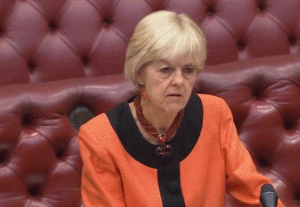 The news that the government is to introduce compulsory Client Money Protection (CMP) for agents made the national newspaper headlines recently. But the strenuous attempts to have it introduced have been in full swing now for over three years.
And it’s 68-year-old Diane Hayter (pictured, right), or to use her Lords title Baroness Hayter of Kentish Town, who has been instrumental in persuading the current government to bring in CMP. So how did it all happen?
After a distinguished career in the Labour Party, her unexpected involvement began when she chaired the now-defunct Property Standards Board, which was set up in 2009 by the Royal Institution of Chartered Surveyors with several other industry organisations including the NAEA and ARLA.
It tried to bring in initiatives including proper regulation of agents but was disbanded a year later when it was clear the government was reluctant to get involved in regulating the industry. How times have changed.
 David Cox (pictured, left), Chief Executive of the Association of Residential Letting Agents, says he first came across Baroness Hayter at a lobbying meeting during the 2014 Labour Party conference in Manchester.
“We were sat around on plastic chairs and I began my spiel on why the industry needed CMP, and she stopped me within a few seconds and said I needn’t worry – she was on board – which was pretty amazing,” he says.
After that meeting, Baroness Hayter then launched her first attempt to bring in compulsory Client Money Protection via the Human Rights Act in the Lords, but this was then rejected by MPs in the House of Commons.
A second attempt, this time through the Housing & Planning Act, also nearly succeeded after gaining support from Labour and the Lib Dems in the Lords, but was subsequently thrown out.
“Baroness Hayter was able to put together a mini-coalition to support the introduction of the amendments which was invaluable for us – as outsiders it’s just not possible to have that influence,” says David Cox.
“She recognised that CMP was a huge consumer step forward and she tried pushing it through any way she could, until the government listened.”
And her work finally shone through just after the then housing minister Gavin Barwell spoke at last year’s ARLA conference in London.
“At the conference the minister said they weren’t going to mandate CMP and then eight working days afterwards, he did an entire U-turn and announced that it would be introduced,” says David Cox.
“He would have received a standing ovation is he’s done it eight days earlier.” Baroness Hayter would no doubt agree.