Housing Market
News covering issues affecting the UK residential property market, house prices, interest rates and buying and selling trends.
-

New housing minister is former pensions under secretary Kit Malthouse
A new housing minister has been announced just hours after Dominic Raab left the post and his name is Kit Malthouse, Tory MP for North West Hampshire. Malthouse was until today Parliamentary Under-Secretary of State for Family Support, Housing and Child Maintenance at the Department of Work and Pensions. One of his key responsibilities has been to oversee the implementation of Universal Credit. The 51 year-old-has former accountant has limited experience of property or the housing market. His previous political jobs have included being a councillor in Westminster during the late noughties, rising to be deputy leader of the council. During his time there he became famous for agreeing its deal to extract £12.3 million from its former leader Shirley Porter. He was then elected onto the London Assembly until 2012, during which he became Deputy Mayor of London for policing under Boris Johnson, and then Deputy Mayor for Business and Enterprise until 2015. housing minister Malthouse was then selected to be MP for the safe seat of North West Hampshire, which he won by nearly 24,000 votes in the 2015 election. Despite working for former foreign secretary Boris Johnson, Malthouse is from the centre of the Conservative Party and…
Read More » -

Dominic Raab quits as housing minister after seven months in role to become Brexit secretary
Brexiteer and ex-solicitor Dominic Raab has quit his housing secretary role to become Brexit minister following departure of David Davis.
Read More » -

Review and likely overhaul of Rent a Room tax break revealed
An investigation into the effectiveness of the Rent a Room relief and other tax breaks given to private home owners who take in lodgers has begun eight months after it was revealed by the Chancellor in his 2017 Autumn budget speech. The Rent a Room relief enables home owners to earn up to £7,500 in rent tax free and was first introduced in 1992. Then, last year, an additional tax-free allowance of £1,000 was introduced for any other income earned from a home. HMRC and HM Treasury are jointly running the consultation and say they want to understand how many people are using the Rent a Room relief and also the impact it’s having on local private rental property markets. The original reason for introducing the relief was to increase the supply and variety of low-cost housing in the private sector, but the consultation document suggests civil servants are worried that it has instead fuelled a boom in Airbnb short-term booking by holiday makers and business travellers. “The government would like to hear views on whether this is an appropriate use of tax relief, or whether the relief should more explicitly support residential accommodation provided on a longer-term basis, or…
Read More » -

Government to introduce mandatory three year tenancy contracts
the government has revealed that it intends to introduced a mandatory three year minimum tenancy contract for all tenants.
Read More » -

7,000 estate agent businesses finding it tough going, says report
A slower and smaller sales pipelineand the looming tenant fees ban are taking their toll on many sales and letting agents, a leading accountancy firm says.
Read More » -

Irish estate agent to market properties only after sale contract prepared
Am Irish estate agent has said vendors must prepare a contract of sale for their property and iron out any conveyancing problems before marketing begins.
Read More » -

London Mayor Sadiq Khan launches affordable homes portal
Mayor of London Sadiq Khan has launched a property portal that offers affordable homes to buy in the capital.
Read More » -

Santander and Legal & General bosses appear to disagree over challenges faced by first time buyers
The mortgage arm of Santander has claimed today that owning a home is cheaper than renting in all areas of the UK and that first time buyers shouldn’t be put off by the challenges of saving up a deposit because of the costs gap of owning rather than renting a property. Santander reckons first time buyers in the UK can on average save £2,250 a year by owning a property, and £3,648 in London. “Many first time buyers understandably focus on the challenge of saving for a deposit and wonder how they will afford a property,” Miguel Sard (right), Managing Director of mortgages at Santander UK says. “However, it is often assumed that when you purchase a property you will be under greater financial pressure and our research shows the reverse is true.” But Kevin Roberts of Legal & General Mortgage Club (below) has been quick to point out today that the almost impossible task faced by many first time buyers to save up a deposit means many are unable to access the annual ‘savings’ to be made from owning versus renting that Santander is so keen to tout. “For many aspiring homeowners, saving for this initial deposit is easier said…
Read More » -

Peers debate doubling of empty homes tax to force more into sales and rental markets
Many thousands of additional homes may be added to the sales and lettings market next year if new legislation being debated today in parliament becomes law. Peers are to complete the committee stage of the Rating (Property in Common Occupation) and Council Tax (Empty Dwellings) Bill this afternoon to consider allowing councils to double the premium they charge on their local council tax rate if a property is ‘long term empty’ or for more than two years. This would increase from 50% to 100% for homes not occupied for more than two years, peers have been debating during the bill’s first two readings in the Lords. It’s a measure that is part of attempts to help councils reduced the number of empty homes in the UK. “This means that local authorities will have the discretion to double the council tax bills of properties that have been empty for two years or more,” said Welsh peer Nicholas Bourne (left) He revealed during his speech that the existing measure of a 50% premium had already dramatically reduced the number of homes that are long-term empty since it was introduced in 2010. The number of properties that are long-term empty has reduced by…
Read More » -
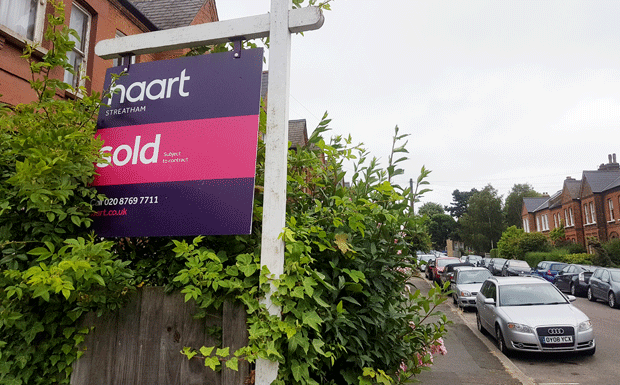
New property sales instruction rise for first time in 27 months, surveyors say
The number of new property sales instructions increased last month for the first time in more than two years, surveyors have reported, helped in part by rising buy-to-let activity. This promising news for estate agents is contained within the latest market survey from RICS, which says there a “few signs of life as houses start to come back on to the market”. Agents shouldn’t crack open the bubbly quite yet. RICS also says average stock levels per branch remain not far above recent historic lows at an average of 42.5 properties. “It therefore remains to be seen whether the increase in May truly marks the beginning of supply pressures easing,” it says. Also, nearly a fifth of member surveyors canvassed by RICS said the number of valuations they completed last month was lower than the same period last year. The institute also says that recent declines in buyer interest are beginning to ease off, and that the number of agreed sales has held steady as more surveyors report positive results, the best RICS has recorded for over a year. “Although agents are suggesting that a little more supply may have come onto the market in May, some of it from…
Read More »