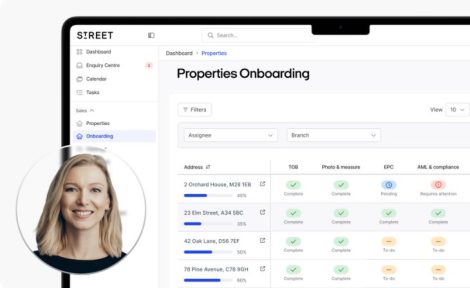
Fast, flexible and feedback-driven – how Street Group is rewriting the rules of agency tech
The Negotiator talks exclusively to Street Group co-founder, Tom Staff, about the key components of building successful agency tech at speed.
Street Group, the Manchester-based proptech behind Street.co.uk and Spectre, is trying to change that perception – and, in the process, to shift the expectations of an entire industry.
“We release about 60 times a day across the business,” says co-founder Tom Staff. “Small bits of work get released all the time. And then in terms of features, we do probably about 250 a year. That’s significant changes to functionality or new bits of kit.”
This pace is unusual in property software. Where many providers still treat annual upgrades as milestones, Street Group pushes code live weekly, even daily. “There’s a principle in engineering called having a DevOps culture,” Staff explains. “It’s small, quick releases all the time. That way you’re always moving forward, always learning.”
Spectre Lettings V2: A case study in change
That philosophy doesn’t mean the company avoids major launches. This summer, Street Group unveiled Spectre Lettings V2, a full rebuild of its popular landlord prospecting tool. “We were the first to bring out a dedicated lettings prospecting tool, and v1 was very successful,” Staff says. “But lettings itself is changing a huge amount.”
The shift he describes is one most agents will recognise: fewer accidental landlords with single properties, more institutional and portfolio landlords operating at scale. “The methods of going after those landlords are completely different,” Staff notes. “And what we also saw was that larger agents were using Spectre Lettings in a very different way to smaller ones – and being phenomenally successful.”
It identifies who is at the top, even if they own it through 15 different special purpose vehicles.”
V2 reflects that reality. It integrates with LinkedIn, pulls records from agents’ CRMs, cross-references against Street’s own data, and builds a picture of landlord portfolios, even when properties are hidden behind complex company ownership structures. “It identifies who is at the top, even if they own it through 15 different special purpose vehicles,” says Staff.
An AI-driven feature called nudges then flags opportunities for contact. “It’ll essentially highlight opportunities where you would have a reason to call them anyway – maybe it’s been a year since you last visited one of their properties. Then it gives you a couple of key points to hit during the conversation.”
The results, even in early use, are promising. “Our guinea pig number one is always my dad,” Staff laughs. “He’s still an agent with a single-branch agency. One of his old landlords came up in nudges, he gave them a ring, and they’re going for lunch tomorrow. That’s a portfolio of 25.”
Cross-functional muscle
What makes this pace of innovation possible? In part, sheer investment. “Our spend on research and development far outstrips anybody else in the industry,” says Staff. “We’ve got over 90 people in engineering. As far as we’re aware, that’s significantly bigger than anyone else in the sector.”
But it’s not just numbers. Street Group’s teams are deliberately cross-functional. “Each team has all the expertise it needs to deliver autonomously – a product owner, an embedded UX designer, developers, testers. Some of the big CRMs don’t even have UX designers, which is absolutely mad. We’ve got UX in every single team.”
We had an agent suggest a change through live chat the other day – it was live 90 minutes later.”
This autonomy means agents see results quickly. “We had an agent suggest a change through live chat the other day,” Staff recalls. “Average time to speak to a real person is 37 seconds. They suggested a new option in our property information questionnaires. It was a good idea – and it was live 90 minutes later.”
Built for agility
Behind that agility lies a set of deliberate architectural decisions. Staff is clear that speed isn’t just about pushing code quickly – it’s about laying the right foundations.
“When we started designing Street, we spent a lot of time on the data model underneath. We wanted it to be representative of the real world. So a person only exists once – but they can also be an applicant, a vendor, a landlord, or a tenant. That makes the data structure more complicated to build with, but it pays off later.”
The payoff is visible in integrations. “Because of those decisions, if you want to connect to a third-party software, it’s super easy. We’ve got a genuine single source of truth and an open API – which nobody else in the industry does.”
This stands in contrast to legacy systems. “In some of the older CRMs, applicants exist multiple times and that creates a mess. Poor decisions to develop quickly at the start slow you down massively later. Our phrase is: slow down to move fast.”
Property knowledge meets engineering
The company also prides itself on combining technical expertise with industry know-how. “The core of our team is probably three buckets,” Staff explains. “We’ve got the top engineers who are extremely good at what they do. We’ve got about 50 ex-agents working in commercial and product roles. And then we’ve got our SaaS experts – around 40 people who bring software knowledge from other industries.”
This mix matters. “All of our engineering and delivery teams are in the office. We don’t outsource, we don’t hire remote. That means they develop deep domain knowledge. If they’re ever unsure, there are 50 people they can walk across the office and ask: would an agent do this?”
StreetLabs: Agents in the room
Feedback is not an afterthought. Street Group runs StreetLabs, a voluntary community of agents who get early access to new features. “Agents are incredibly engaged,” says Staff. “In other industries, it can be hard to get feedback. With estate agents, they love giving suggestions because historically, they never heard anything back. Now, when they see their ideas implemented, they’re even more motivated.”
It’s a community of tech-forward agents who test features as they’re built.”
StreetLabs isn’t about bug-hunting, but about usability. “It’s a community of tech-forward agents who test features as they’re built. Some of them even created their own WhatsApp group, where they play with the API and share what they’ve built. It’s genuinely fantastic to watch.”
Sometimes, feedback challenges assumptions. Staff admits one of his own ideas was overturned by the data. “We thought it would look better if valuation reports were delayed before sending – like you’d gone back to the office and written it up. But the data showed the opposite. Faster you send it, the higher the instruction rate. If you literally walk back to your car, put the numbers in, and hit send, you’ve got a 5% higher instruction rate.”
Keeping agents in the loop
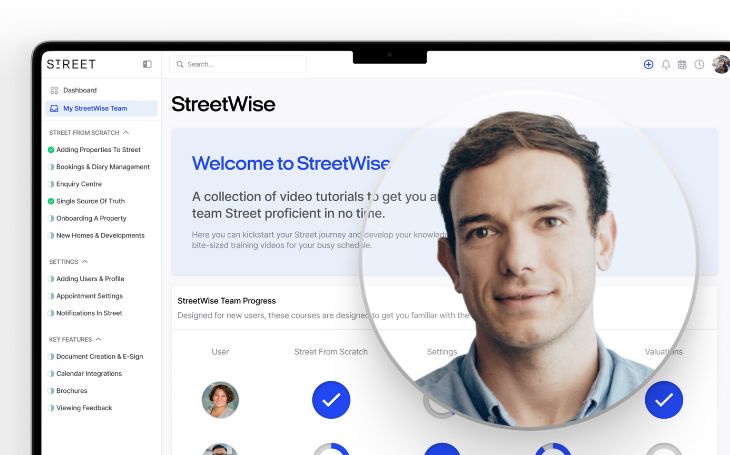
Releasing features quickly only works if agents know how to use them. Street Group uses a multilayered approach: in-app notifications, product update emails, helpdesk articles, video explainers, and a training academy called Streetwise.
“Every new feature has supporting content,” Staff says. “Our AI bots are trained on it before it goes live, so you can ask the bot and it knows what to do. And, of course, there’s always live chat support.”
With good UX…you should be able to look at a new feature and know intuitively how to use it.”
But the real defence is design. “With good UX, you shouldn’t need training. You should be able to look at a new feature and know intuitively how to use it. That’s why we embed UX designers in every team.”
The migration hurdle
Ask any agent why they haven’t switched CRM, and the answer is often the same: fear of migration. Street Group tackled this head-on with Bridge, a bespoke migration tool.
“It takes your export from your previous CRM, automatically cleans the data, dedupes it, and pipes it into Street,” explains Staff. “It handles 99% of the work automatically. Then we’ve invested heavily in onboarding teams – engineering, commercial, and support. We’ve even got a conversational AI trained on our entire knowledge base. You can ask it any question about Street and it’ll answer like a support agent.”
The company has spent over £2.5 million on migration alone. “We know the terrible onboarding experiences of the past are why some agents refuse to move. But we’ve got testimonial after testimonial saying it was seamless – nothing like what they expected.”
A changing industry
The old CRMs are holding the industry back.”
Staff believes the industry as a whole isn’t moving fast enough. “There are a lot of good solutions around the core CRM, but the CRM systems themselves haven’t changed in literally ten years,” he says. “Meanwhile, in the wider world, every month there’s a paradigm shift in what’s possible. The old CRMs are holding the industry back.”
Street, meanwhile, is growing fast – doubling its agent numbers year on year. “We’re probably the third biggest CRM already. Within a year, I think that will change.”
What’s next
Alongside Spectre Lettings V2, Street Group is preparing to launch Spectre Websites, an industry-first no-code website builder built for estate agents. “Out of the box, it works with Street – properties, valuations, booking, branch syncing – and it’s free to build with affordable hosting,” Staff says.

Further ahead, the company is exploring payments functionality. “Agents get squeezed with compliance, and those costs add up. Larger agents often pass them on through small admin charges, but smaller ones don’t. We’re working on ways to make that easier.”
Agents should demand innovation at pace from their providers. If you’re not seeing that, maybe it’s time to ask why.”
For Staff, the goal isn’t just to grow Street Group, but to raise expectations across the industry. “Agents should demand innovation at pace from their providers. If you’re not seeing that, maybe it’s time to ask why.”
Street Group’s approach – rapid iteration, deep feedback loops, strong architecture, and a mix of tech and property expertise – may not be the only way forward. But it’s setting a new standard. And in an industry where technology is often accused of lagging behind, that in itself feels newsworthy.