Auction market broadens as sales rise across most regions
EIG’s latest analysis shows residential auction sales continuing to grow, with flats accounting for a rising share and regional differences in prices and demand.
 The residential auction market is continuing to broaden, with EIG’s latest Property Auction Insights highlighting a growth in sales, changing patterns of residential stock and significant differences between regions.
The figures show sales increased in 12 of the 13 regions in the first six months of 2026, while flats are becoming an increasingly significant part of the market.
At the same time, the range of prices and property types being sold demonstrates the breadth of opportunities available through auction.
The report also highlights the continuing role of auction for properties where buyers may need to consider factors such as leasehold arrangements, works required or existing tenancies.
Focus on flats
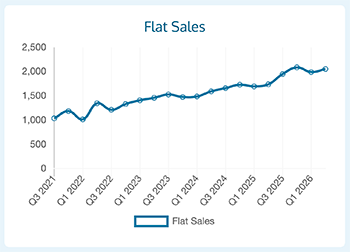 Quarterly flat sales have broadly doubled since 2021, while their share of residential auction sales reached 27.2% in the second quarter 2026 – its highest level across the period analysed.
Flat sales were 18.1% higher than in the second quarter of 2025, with increases recorded across 11 of the 13 regions in the first half of 2026. Yorkshire & The Humber recorded the largest percentage increase at 29%, followed by London at 27.6%.
Price is also likely to be contributing to their appeal. Almost half of flats sold at auction in the first six months of 2026 were below £100,000, while 60.6% sold for less than £150,000 and 79.2% for less than £250,000.
EIG notes that lease length, service charges, ground rents, cladding, building safety requirements and major works can all affect buyer appetite and mortgageability. Auction can nevertheless provide a route to market for properties that may be more difficult to sell through conventional channels.
Rise across most regions
The broader residential auction market also recorded growth across almost the whole country, with sales increasing in 12 of the 13 regions in the first half of 2026.
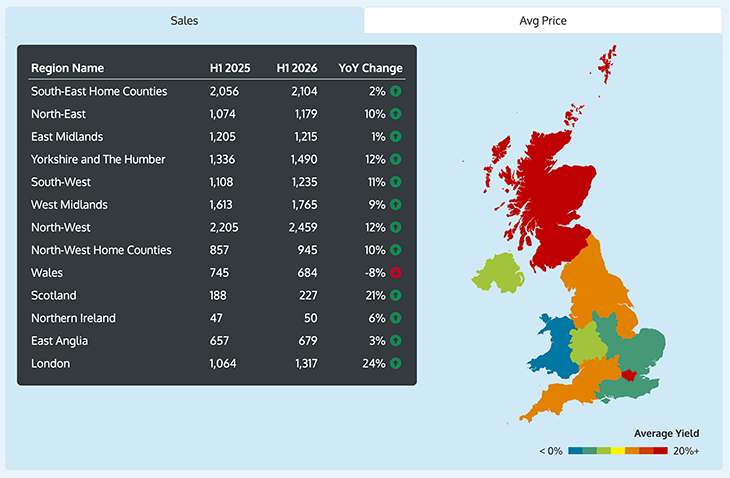
London recorded the strongest growth among the larger markets, with sales up 24%, followed by Yorkshire & The Humber and the North-West, both up 12%. The South West increased by 11% and the North East by 10%.
Scotland recorded a 21% rise, although from a much smaller base, while Wales was the only region to record a fall, with residential sales down 8%.
For buyers, the increased activity means greater choice. Some 37% of residential auction sales in the first ha;f of 2026 were below £100,000, 58% were below £150,000 and 81% were below £250,000.
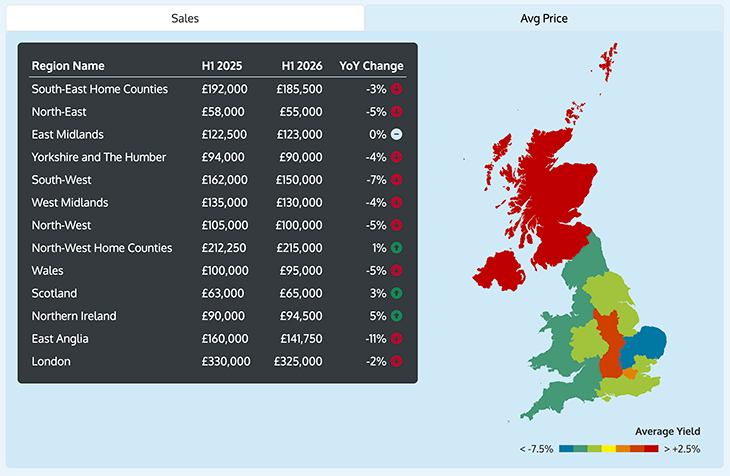
Average auction sale prices ranged from £55,000 in the North-East and £65,000 in Scotland to £325,000 in London, highlighting the breadth of stock available across the regions, although most of the averages are down slightly on the same period in 2025 .
Continued flexibility for sellers
The latest figures also demonstrate the range of circumstances in which residential auction is being used.
Tenanted properties accounted for 10.2% of residential auction sales in the first six months of 2026, compared with 9.9% in the same period in 2025 and 13.3% in the first half of 2024.
While EIG says it is still too early to assess the longer-term impact of the Renters’ Rights Act on auction activity within the private rented sector, auction remains an established route for landlords looking to sell with tenants in situ.
More broadly, auction can provide sellers with a route to market where speed, certainty or transparency are important, while giving buyers access to a diverse range of properties, including investment opportunities and homes requiring refurbishment.
Industry comment

Stuart Collar-Brown, President of NAVA Propertymark, said: “EIG’s latest report reflects how auction has firmly established itself as an important part of the property market. For sellers, it can provide speed and certainty, while for buyers it can open up opportunities to purchase a wide range of property.
“As auction becomes more familiar to the public, it is important that consumers understand what makes the process different from a traditional sale. Buyers should have access to clear information about the property, the legal pack and any additional costs, so they can bid with confidence and know exactly what they are committing to.”