What’s really happening to house prices?
House price reports What’s really happening to house prices? Jeremy Leaf endeavours to make sense of the various property market surveys.
 A client recently told me that he had read two conflicting surveys about house prices but didn’t know which to trust. The Government’s new UK House Price Index from ONS and Land Registry reported that property market activity in England and Wales was slowing whereas Rightmove said house prices were still going up. The answer is that they’re probably both right and both wrong!
In addition to various inconsistencies, the compilation of the indices is generally a mathematical exercise, whereas home buying, as you know, tends to be more emotionally led.
RELIABLE INDICATORS?
Although long established and fairly current, Rightmove’s asking prices for England and Wales are seasonally adjusted, offer a regional breakdown and a useful measure of average time to sell homes.
On the other hand, selling prices in the ONS/Land Registry report are also seasonally adjusted, include properties bought with mortgages and up to around 40 per cent of ‘cash’ buyers but don’t reflect the delay of up to two months between the report’s compilation and publication.
Data from Land Registry, which has provided the largest monthly sample of completed transactions in England, Scotland and Wales and Northern Ireland since 1995 has now joined forces with ONS to produce the UK House Price Index (HPI).
The new measure produces separate monthly figures for England, Scotland and Wales based on completion prices of all properties – with or without mortgages – as well as newly built homes and those occupied for a long time, but it could still be around two months out of date.
Perhaps of more concern is that the use of data from the Valuation Office to compile this index could be used to assess the council tax of every home in the country!
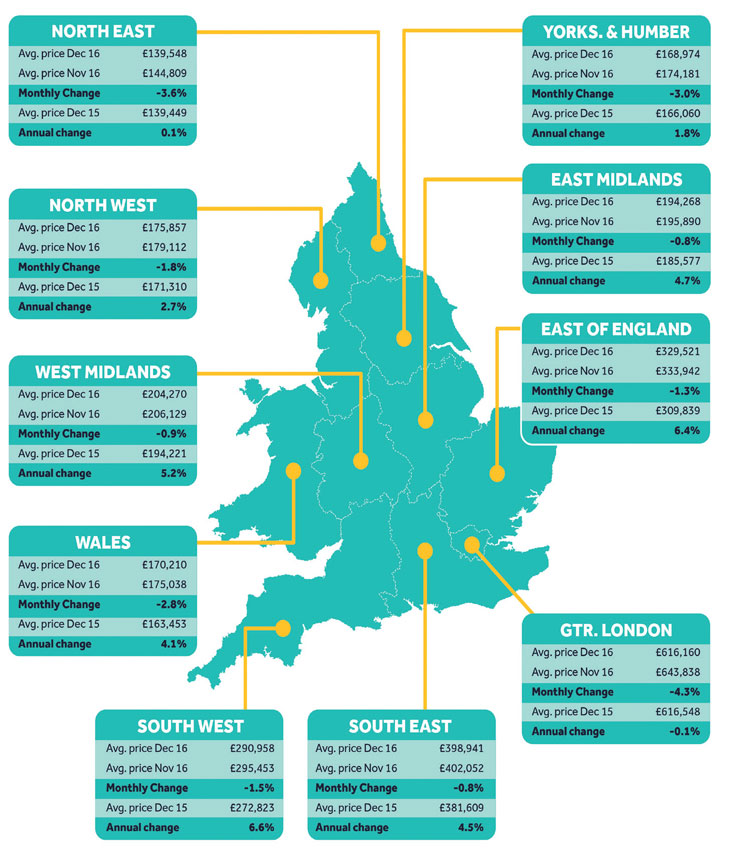
NATIONWIDE VS HALIFAX
Other surveys can produce confusing results too. For instance, Nationwide said last month that house prices slowed for the first time in 15 months but had risen modestly over the past year. Conversely, Halifax believes that annual house price growth is now accelerating for the first time in eight months!
Nationwide has been producing housing reports since the mid-1980s, is the first to be released every month and uses an average value for UK properties at the time mortgages are approved – not when sales are completed.
Figures take account of property location and size, but are generated from the building society’s own mortgaged stock which is concentrated towards the south of the country and constitutes around 13 per cent of the total.
Halifax, which is part of the Lloyds Banking Group and the largest mortgage lender in the UK covering around 20 per cent of the market, has provided similar data on property prices as Nationwide around the same time but publishes a few days later each month.
The Halifax survey is also based on mortgage approvals not completed sales of its properties, which are situated more in the north of the country but lacks a detailed regional breakdown and is said to be more active in the new homes sector.
OTHER CONTENDERS
Of the alternatives, the Royal Institution of Chartered Surveyors (RICS) has proved to be a reliable identifier of supply/demand trends and turning points for the UK residential property market since 1978. Their monthly report was described by Goldman Sachs as “the best lead indicator of house prices in the country.” On the other hand, RICS doesn’t include price data and numbers are taken from a relatively small sample.
The National Association of Estate Agents (NAEA) tracks sales, and provides supply/demand figures from UK estate agents but has concentrated particularly on first time buyer sales recently.
Hometrack has been producing a house price index which compares prices annually and quarterly every month for over 20 years but more recently has covered movements in major cities in England, Wales and Scotland only, rather than the whole country.
MAKING HOUSING MARKET JUDGEMENTS
Different house price survey outcomes based on varying methodology mean the market may be regarded as much stronger or weaker than it really is, which compromises decision making.
In addition to inconsistencies, compilation of the indices is generally a mathematical exercise, whereas home buying tends to be more emotionally led.
For instance, selling prices based on a rate per square foot or metre may reflect a south facing aspect, property condition, larger gardens, the ‘premium’ paid by some to live in a particular school catchment area or close to family and friends.
Accurate pricing is even more important now that the market appears to be entering a period of uncertainty following the EU referendum.
Establishing a clear direction for the property market is virtually impossible as no two homes are the same. Market surveys can never be more than a guide to actual house price movements, so many commentators rely on an average of the main indices.
Jeremy Leaf is a former RICS Residential Chairman and Independent North London Estate Agent.