Reform-run city launches huge crackdown on HMO sector
Local Reform councillor in Stoke echoes party's national leadership, saying there are too many HMOs in the city.

The city of Stoke-on-Trent has revealed one of Britain’s most draconian crackdowns on HMOs as its Reform-run council reacts to voter concerns that too many properties of this kind are ‘tearing streets apart’.
Its new measures include an Article 4 Direction removing automatic developments rights when family homes are converted into HMOs, which currently do not require planning permission.
Also, the council is proposing to cap the total number of HMOs in each of the city’s wards.
This will be set at 4% of residential properties for wards where there are already a very high number of HMOs, 2.5% for wards where there are a high number, and 1.5% for all other wards.
The rules say there cannot be two HMOs side-by-side with a single frontage, and other homes should not be ‘sandwiched’ between two HMOs.
Stoke-on-Trent is also now consulting an a city-wide ‘additional licensing’ scheme, which will if approved put all the city’s smaller HMOs under regulation.
The proposals – which will be considered by the city’s cabinet next week – are part of drive to limit the growth of HMOs and address concerns raised by residents about the impact of high concentrations of shared housing, although the council says it wants to ‘strike a balance’.
Proportionate
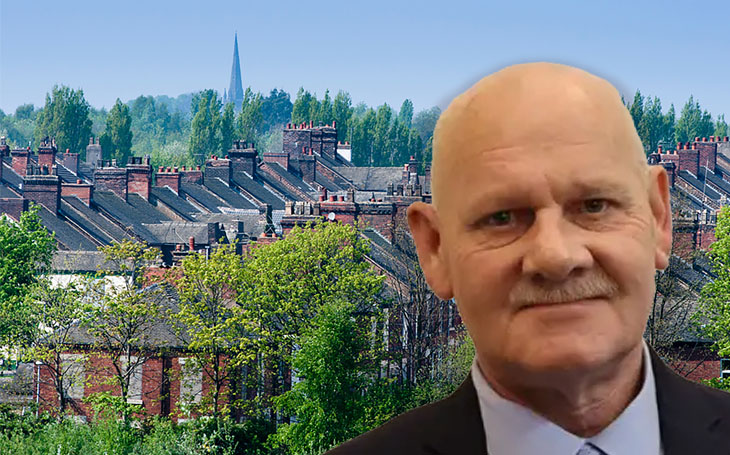
“Houses of multiple occupation have a place in terms of meeting the significant housing needs within the city – they can be an important step on the ladder for people looking for a home, but they need to be of high quality and proportionate,” says Councillor Duncan Walker (main image).
“For this reason, they need to be strictly controlled to ensure they do not have a disproportionate impact on neighbourhoods and are of a sufficiently high standard. So, we are proposing to take the toughest action we can to ensure this.
“The evidence in Stoke-on-Trent shows HMOs are concentrated in a number of urban neighbourhoods, and that the impact – in terms of noise, waste, and demand on parking – are most acute where concentrations are highest.”
The announcement follows a trend – several other Reform-run councils have announced similar albeit not such extreme crackdowns including earlier this year in Newcastle.
The Reform MP for Ashfield Lee Anderson, recently told fellow MPs during a speech in parliament that he wanted to see “landlords and managers… held accountable for managing their [HMO][ properties, as well as for disruptive behaviour [by tenants]”.