Interest rates rise for first time in three years
In a blow for mortgage borrowers, the Bank of England has hiked interest rates to 4% in an effort to keep rising inflation under control.
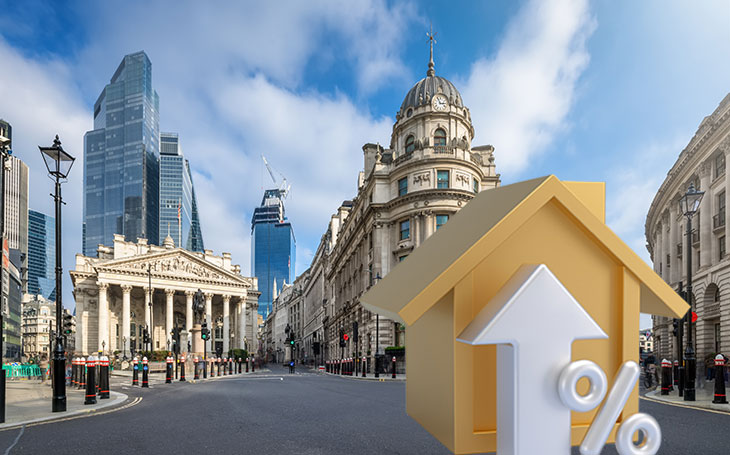
The Bank of England has increased interest rates for the first time in three years, from 3.75% to 4%.
Policymakers on the Bank’s Monetary Policy Committee (MPC) voted unanimously to increase the Bank Rate.
The decision comes as the central bank seeks to keep inflation under control amid rising fuel and energy costs due to the Iran conflict.
The inflation rate rose from 3.1% in August to 3.5% in September, meaning it remains way above the Bank of England’s 2% target.
The Bank of England previously raised interest rates in August 2023, when the MPC increased the cost of borrowing by 0.25 percentage points to 5.25%.
Interest rates began coming back down again during 2024 and 2025 when inflation was thought to be under control and had been held at 3.75% since December 2025.
The latest rise could mean mortgage costs surge even higher for homebuyers, potentially denting housing market confidence further.

Kevin Shaw, National Sales Managing Director at LRG, says: “Today’s rise to 4% will come as little surprise. Lenders have largely priced it in already, so the direct effect on mortgage rates should be limited, even if some edge their rates up slightly. The bigger impact is on sentiment, because a rate rise makes the headlines. But it’s a moment in time, not a turning point. We may see one more rise in the early part of 2027, taking rates to 4.25%, but I’d be surprised if they went any higher.
“What the market has now is clarity. The Budget has come and gone without any real curveballs for buyers and sellers, and today’s decision is out of the way. This time last year, the housing market spent much of the final quarter treading water while it waited for the Budget. This year, people know where they stand, and we’re cautiously optimistic about the start of 2027, when we expect the usual seasonal upturn as more buyers return.
“Prices have been correcting for the past two or three years while average wages have risen, so affordability is gradually improving, even if it’s still stretched. Broadly speaking, we expect prices to be flat next year, although that will vary from one local market to the next. The Your First Home scheme should also bring some energy to the market. It’s aimed at new-build homes, but it gets first-time buyers thinking about buying, and once they’re on that journey, they’ll be looking at the wider market too.
“For buyers sitting on the fence, now is a good time to act. Get mortgage advice and start looking now, because there’s every chance of a better deal in the weeks before Christmas than in January or February, when demand picks up.
“For sellers, take the pricing advice of your agent seriously and get market ready now. It’s easy to assume you can call an agent in early January and be on the market the next day, but compliance checks, photography and marketing take around ten days to get in place, so it’s worth starting before Christmas.”

Amy Reynolds, head of sales at Richmond estate agency Antony Roberts, says: “Today’s rate rise has been largely priced in already. Fixed-rate mortgages have been heading towards 6 per cent for weeks, and mortgage approvals have dropped to their lowest level in almost three years.
“On the back of this, we expect a quiet December for the housing market and a slow start to 2027. The sellers who still get deals done will be those who price realistically from day one.”

Jeremy Leaf, north London estate agent and a former RICS residential chairman, says: “The Bank of England must weigh up concerns about rising inflation as Middle East hostilities show little sign of ending any time soon, against the prospect of choking off any growth in the economy.

Nathan Emerson, Chief Executive at Propertymark, says “As the Bank of England continues to navigate wider economic pressures, including rising inflation, it comes as little surprise that base rate decisions remain focused on maintaining economic stability.
“While these decisions are never straightforward, the Bank of England must carefully balance the need to control inflation against the wider impact that borrowing costs can have on households.
“Last week’s Autumn Budget acknowledged several important consumer concerns, including rising energy costs and the ongoing challenges facing many first-time buyers. Measures aimed at addressing some of these pressures are focused on stability, particularly where they could help improve access to homeownership and ease the long-term financial burden on households. Over the coming months, much will depend on how inflation and consumer confidence evolve.”
 Iain McKenzie, Chief Executive of The Guild of Property Professionals, says: “An increase to 4% is another reminder that the property market cannot operate in isolation from the wider economy.
“Higher borrowing costs inevitably influence what buyers can afford, and sellers need to recognise that this places limits on achievable prices.
“However, it’s important not to overstate the impact. The market has continued to function in a challenging financial environment, with transaction volumes holding up relatively well despite higher mortgage rates and economic uncertainty.
“What we’re likely to see is an even greater emphasis on value. With buyers enjoying more choice, sellers who price ambitiously could find themselves waiting considerably longer to secure a sale.
“The most important consideration remains what’s happening on the ground locally. Accurate valuations, realistic expectations and a strong understanding of buyer demand will be essential for anyone looking to sell successfully.”

Richard Donnell, Executive Director at Zoopla, says: “Higher mortgage rates have been a drag on housing market activity since the Spring with sales agreed down 8% on last year and this latest increase in the base rate set to make more buyers pause and wait on their home buying decisions.
“Current mortgage rates already reflect financial market expectations of four further base rate increases, meaning average mortgage rates are unlikely to rise significantly in the short term unless those expectations change.”
“While there are fewer sales than this time last year, sales that are being agreed are happening just as quickly as a year ago as serious buyers become more selective. There is demand to buy homes but sellers need to price their homes carefully to ensure they attract the active buyers.”

Nicky Stevenson, Managing Director of Fine & Country, says: “Today’s decision to increase interest rates to 4% will undoubtedly be disappointing for buyers who had been hoping for some relief from higher borrowing costs. However, with inflation continuing to prove stubborn, the Bank of England is clearly prioritising getting price pressures back under control.
“For prospective buyers, the message is to be financially prepared rather than put plans on hold indefinitely. Understanding affordability, securing mortgage advice early and allowing some flexibility in monthly budgets will be particularly important in the current environment.
“An increase in Bank Rate doesn’t automatically translate into an equivalent rise in fixed mortgage rates, but it can influence borrowing costs and buyer sentiment.
“People will always need to move home, and while some may choose to reassess their plans, well-priced properties in desirable locations will continue to attract interest.”

Jason Tebb, President of OnTheMarket, says: “As expected, the Bank of England increased base rate to 4 per cent this month.