
Housing Market
News covering issues affecting the UK residential property market, house prices, interest rates and buying and selling trends.
-

Over half of tenants CHOOSE to rent, says survey
If you are annoyed by the constant government narrative that all those who rent are unhappy, failed home owners denied the delights of bricks and mortar by high house prices and unhelpful lenders, then research by London agent Benham & Reeves Residential Lettings should cheer you up. It interviewed 1,400 of its tenants in the capital, where it has four branches in North London, to ask them about why they rented – part of the largest survey of its customer base that the company has ever completed. Diverse mix London’s very diverse mix of tenant nationalities was revealed. Some 18% of the respondents were non-British residents working for a relatively short period in the capital – and therefore less likely to buy in London. Only 3.66% of those in the survey were renting because they had been turned down for a mortgage because they did not earn enough, while 5.76% had been turned down because their deposit was not large enough. Some 17.8% of those in the survey said they were saving up a deposit to buy a property. But over half of tenants in the survey classed themselves as ‘lifestyle’ renters with 24% saying they chose to rent because it…
Read More » -
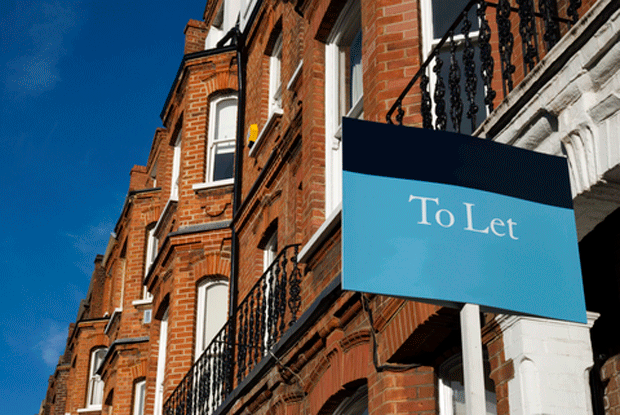
Stamp Duty deadline for landlords creates glut in property rental market
A glut of homes created by last year’s landlord rush to buy before the extra ‘second home’ Stamp Duty kicked in has slowed down the rental market significantly, it has been claimed. In the UK letting agents are taking 10% longer to find tenants, and 20% longer in London, says Rightmove, as the number of properties available to rent on the portal increased by 12%. Rental market growth halves This has halved the rental growth figure for the first quarter of 2017 compared to the same period last year, down from 3.9% to 1.8% across the UK, Rightmove says. And outside London, the average rental price dropped for the first time since 2014, down by 0.4% on the previous quarter, while in London they increased by 1.5% compared using the same comparison. “The supply boost following last year’s buy-to-let frenzy in the first few months of the year has continued through to 2017, introducing more competition in the market for letting agents trying to secure suitable tenants for their landlords’ properties,” says Rightmove’s Head of Lettings Sam Mitchell (pictured, left). Sam, who before joining Rightmove was for a short period CEO of Sotheby’s International Realty and before that worked at Your Move…
Read More » -

Parents paying £52k extra for homes in Outstanding primary school areas
Agents are used to parents quizzing them endlessly about properties for sale within the catchment areas of the best local outstanding primary schools. And now a price has been put on this fixation. Parents pay an average price premium of £52,000 to live in the successful admission area of an Outstanding Ofsted-ranked primary school, a report from Rightmove has revealed. The figure is based on the cost of moving from the catchment area of a Requires Improvement school to an Outstanding one. The portal, which partnered with school search engine FindaSchool by 192.com to produce the report, also says that to move from an area around a Good school to and Outstanding costs on average £37,000. “Previous studies have shown links between outstanding schools and house prices, however our data is the first data that is based on whether the property would have secured a place at the school,” says Dominic Blackburn from 192.com (pictured, left). Fierce competition Driving the fierce competition for places at the best school are some starting facts. Across England 86% of Outstanding state primary schools are oversubscribed and only 20% of all schools have Outstanding status and 62% are Good. The areas with the biggest premiums…
Read More » -

Property prices: Are TV series worth all the drama?
When a TV drama announced that it’s going to film in an area, it can be exciting for local estate agents and good for property prices. Or at least that’s the theory. As well as the thrill of famous actors mooching about the local area during filming, the saturation media coverage that a famous TV show brings can only be good for business, agents often hope. Recent examples include Broadchurch starring David Tennant and Olivia Coleman (pictured, above), which was filmed on the West Dorset coast; Poldark in Cornwall, Wiltshire and Bristol; and Downton Abbey in Oxfordshire. And for those longer in the tooth, there’s Inspector Morse in Oxford, the Midsomer Murders in Buckinghamshire and Heartbeat in and around Whitby. But does such televisual fame really help make areas more popular with house hunters? Conveyancing firm MyHomeMove.com reckons it does. After crunching Land Registry data the company says popular shows add between 1.2% and 6.6% more to local house values in surrounding areas within a year of the highest ratings for a show. Period dramas “What is particularly interesting in the findings is the correlation between period dramas and the locations they are filmed in,” says Doug Crawford, CEO of…
Read More » -

First-time buyer frenzy
First-time buyer activity rose to 36 per cent of market activity in February...
Read More » -

Hybrid bridging-lender-cum-agent Nested wins £8m of new funding
As if agents needed more competition from digital start-ups, a company called Nested that offers to buy a client’s home if a buyer can’t be found has won a fresh £8 million injection of cash. Launched 14 months ago, Nested promises vendors that it will sell their homes via its own listings on Rightmove and Zoopla within 90 days or provide them with an interest-free loan to buy their next property. Nested is chasing the 40% of home movers in the UK who do not have a mortgage and therefore find it frustrating when they caught in lengthy buying chains. Hefty fee There are some catches to the deal. Nested guarantees to sell a vendor’s property, but only for 95-98% of the asking price in return for a hefty 2.5% sales fee. If the property is sold for more than the valuation range, it splits any ‘profit’ 70/30 in favour of the lender. But if the property does not sell, Nested then takes out a first-charge mortgage on the property and advances the necessary cash to enable the vendor to move home. When the property sells, the ‘bridging’ mortgage is then cleared. “There are lots of people in this situation and…
Read More » -

Tenants begin to get choosy about who they house or flat share with, report shows
Arguments among tenants over unwashed dishes, late night partying and dirty pants left on bannisters are clearly taking their toll, reveals research out today into the house and flat share market. It shows that 70% of house and flat sharer tenants in the UK are willing to pay on average an extra £112 a month to secure a home with more ideal cohabiters. But some told researchers they would stump up even more; £201 a month, which seems a lot just to avoid unflushed loos, stolen orange juice and waiting ages for a shower in the morning. The research found that being clean and tidy was the most important attribute of being a good flatmate among those polled, that men prefer sharing with three others and females two others. Face-to-face Commissioned by utility company Spark Energy, which is a specialist supplier to the lettings market, the research also reveals that half of all tenants still believe the most effective way to meet people to share a home with is face-to-face, despite the best of efforts of websites such as RoomBuddies.co.uk to convert this into a digital interaction. Spark Energy’s spokesperson Shaun Burnett (pictured) also suggests that a ‘behavioural’ trend may…
Read More » -

Tenants are struggling to survive as home ownership declines
Private renters have grown in number by a million since 2010 but these tenants are struggling financially much more than their mortgaged counterparts, according to research carried out by the University of Bristol. Its report on renters, which was commissioned by money website Momentum UK, reveals that renters spend half their salary on rent every month, go on fewer holidays, save less money and are more likely to make forced cutbacks than those with a mortgage. Cut back on food A third of private renters have less than £100 in savings, a fifth have cut back on food expenditure over the past year, 11% have reduce their heating to get by while 14% have borrowed money from friends or family to survive. The research follows recent government figures within the English Housing Survey which revealed that home ownership continued to decline. More than four million households in the UK now rent their home from a private landlord, nearly twice as many as 10 years ago. Within England, homeownership fell to 62.9% last year, the lowest percentage since 1985 and eight points lower than the peak in 2003. “The average private renter loses around half of their pay cheque on rent…
Read More » -

Official house price index highlights sales slide in London and beyond
The total fee slice taken by London estate agents each month dropped by over £20 million between 2015 and 2016, the latest house price index reveals. Today’s figures from the Office of National Statistics (ONS) reveal that the number of completed sales during November 2016 compared to November 2015 fell from 9,800 to 6,400. This, based on an average fee of 1.5%, saw agents’ total revenue for the two Novembers dip from just over £67 million in 2015 to £47 million last year. Completed house sales across England also reduced during the same period, down by 21.2% to 62,500 from 79,300. This reduction in supply is the main driver behind buoyant house price figures, most commentators agree. The figures for completed sales, also released today, show prices rising by 6.2% over the past year. The average price for a property in London is now £490,700 compared to £234,800 in England and £145,900 in Wales, the index says. “With only a week to go until Article 50 is triggered, house prices remain indestructible as the average person is paying £13,000 more to own a home than the same time last year, reflecting the health and buoyancy of the UK economy seen in…
Read More » -

‘Bank of mum and dad’ backed first time buyers driving property market, it is claimed
If you’re wondering which way the property market is moving, then be heartened by the Council of Mortgage Lenders (CML). It says that while the number of home loans dropped 1% year-on-year, the number of first-time buyer loans has increased by 9%, driven in part by parents re-mortgaging to help their offspring get on the property ladder, it has been claimed. The number of first time borrowers in the market hit 337,000 last year, the highest level in any twelve month period since the financial crash of 2008, the CML says. Re-mortgaging activity in the property market increased by 54% between December last year and January this year, and although this is driven in part by competition among lenders to offer lower and lower rates, agent Haart says it’s also driven by ‘bank of mum and dad’ parents. “We are seeing more and more parents on the ground looking to release equity in their homes to support increasing numbers of young people who are leaning on their parents for support to get onto the property ladder,” says Haart’s CEO Paul Smith (pictured, left). “With rents sent to increase as landlords are squeezed, and ONS figures showing that house prices have reached 10 times the average…
Read More »