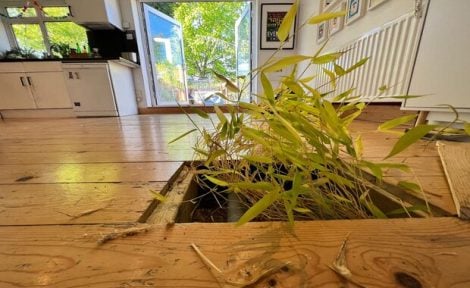
Do estate agents need to worry about bamboo invasion?
Emily Grant of Environet explains how bamboo infestations can lead to price reductions even though there is no TA6 declaration requirement.

Most estate agents are well aware of the problems caused by Japanese knotweed and the law around buying and selling an affected property. Protections for buyers hinge on the TA6 form, which asks a direct question about knotweed and requires sellers to answer honestly or leave themselves open to a legal case for misrepresentation.
Yet unlike knotweed, not all bamboos are problematic, and there is no legal requirement for a seller to declare bamboo in their garden. Nor are agents are under any obligation to point it out. We are, however, increasingly encountering cases where a surveyor has identified a bamboo infestation and recommended further investigation via a specialist bamboo survey.
And as buyers become more aware of the associated risks , they are insisting that problematic infestations are addressed prior to purchase – or an appropriate price reduction is applied.
Bamboo can cause delays and disagreements between buyers and sellers over who should bear the cost of the survey – and potentially the plant’s removal.”
This can cause delays and disagreements between buyers and sellers over who should bear the cost of the survey – and potentially the plant’s removal. It can also lead to transactions falling through where an agreement can’t be reached, or the buyer isn’t prepared to accept the risk of buying the property with the plant in situ.
Bamboo ‘stand-off’
 One of our clients, first-time-buyer Lois Connelly, had noticed bamboo in both the front and back gardens of the terraced house she planned to buy in Bristol, and was further alarmed when her surveyor flagged it on his report, recommending that it be checked by an expert.
Our survey determined the bamboo was a ‘running’ variety – the most troublesome kind – and was already posing a threat to underground pipes and drains, as well as the neighbouring property.
Lois requested a reduction in the price to pay for the bamboo to be removed, but the vendor (supported by their estate agent) refused, stating the work was unnecessary. It was only when she withdrew her offer that the seller finally agreed to a price reduction covering half the removal costs.
Encroachment risks
 In addition to the potential damage to their own property and the associated removal and repair costs, buyers must also consider the risk of legal action if the plant has spread, or is at risk of spreading to a neighbouring property.
One of our clients recounted the shock of answering a knock on the door the day after she moved into her new home, only to be met by her new neighbour asking what she planned to do about the bamboo which had crossed the boundary into their garden.
Of course, sellers are legally obliged to declare any resolved or ongoing disputes with neighbours, but conflict may not yet have arisen over the issue – or the neighbour may at that point be unaware that the bamboo has already spread beneath the ground into their property.
Advice for agents
We’re already seeing an increasing number of transactions impacted by bamboo, and this is likely to continue as awareness grows among property professionals and the public.
To limit the risk of delay, price renegotiation or a fall through, where an affected property is being sold, the best advice agents can offer their clients is to commission their own bamboo survey prior to marketing, to determine whether or not it’s causing a problem or may do so in the future.
If it isn’t they have the evidence to prove it and can easily reassure potential buyers who may be concerned. If the report recommends that the plant is removed, the work can be carried out proactively and an insurance-backed guarantee secured which can be passed on to the buyer.
Environet specialises in expert consultancy as well as the treatment and removal of invasive plants.