
rents
-
Uncategorised

Rent growth slows
Rents on new tenancies remained flat or dropped marginally over the three months to November in 10 out of the 12 UK regions compared to the three months to October, according to research from HomeLet. The latest index data shows that the average UK rent, excluding London, on a tenancy signed during the three months to November was £743 a month, down 0.7 per cent on the previous three month period. In Greater London the average rent was £1,544, down 1 per cent. Only two regions saw rents rise over the three months to November. In Yorkshire and Humberside, rents on new tenancies rose by 0.8 per cent to £626 a month, while in the East Midlands rents were 1.2 per cent up at £635 a month. The study by Homelet also revealed that 91 per cent of landlords do not plan to increase rents in the next six months, while over the next 12 months, just around a third of landlords are planning to increase the amount they charge on their homes. “The research reveals the vast majority of landlords enjoy strong relationships with their tenants and are keen to keep them,” said Martin Totty, Barbon Insurance Group’s Chief…
Read More » -
Housing Market

Stamp duty hikes will push up rents, says IFS
Fewer new homes will be built and rents will rise as a consequence of the hike in stamp duty on buy-to-let unveiled in last week’s Spending Review, the Institute for Fiscal Studies (IFS) has predicted. The Chancellor George Osborne announced that a 3 per cent rise in stamp duty for buyers of second homes and buy-to-let landlords will come into play from April 2016, almost trebling the purchase tax on a typical £275,000 buy-to-let home from £3,750 to £10,800. Osborne believes that the new surcharge on stamp duty for landlords and those acquiring second homes will raise £1billion for Treasury by 2021. The tax change will almost certainly result in an inevitable rush of people trying to secure buy-to-let properties before April’s deadline, which could push up home prices in the short-term. But should the buy-to-let market slow thereafter, as many analysts anticipate, it may enable more first-time buyers, squeezed out by investor-driven purchasers, to buy property, but not if there is a major reduction in the construction of new homes. Stuart Adams, a Senior Research Economist at the IFS, projects that the tax increase could deter property developers, with less reason to invest, slowing down the building of new…
Read More » -
Housing Market

Rents fall in October
Rents across England and Wales dropped by 1.2 per cent fell in October taking the average to £806 per month, according to the latest buy to let index from Your Move and Reeds Rains. Rental price falls were led by the South East where they dropped by 2.5 per cent month-on-month, followed by the South West, down 2.1 per cent, and London where they fell by 1.1 per cent. But despite the fall in rents between September and October, they remain significantly higher than a year ago, with average rents having increased by 4.7 per cent in the 12 months since October 2014. On an annual basis, London leads the way with rents 10.7 per cent higher year-on-year, while rents increased by 8.9 per cent in the East of England and 5.7 per cent in the East Midlands. By contrast, rents in Wales are 6.7 per cent lower than a year ago. With the festive season rapidly approaching, better deals will almost certainly be made available for tenants seeking to rent later in the autumn, but there has been no huge change in the supply-demand fundamentals pushing rents higher than in previous years, according to Adrian Gill (left), Director of…
Read More » -
Housing Market

Jeremy Leaf
Has the Summer Budget busted buy-to-let? George Osborne’s changes to mortgage interest relief and tax could have a serious effect on the market, says Jeremy Leaf.
Read More » -
Housing Market

Average rents continuing to grow
The average rent achieved for a newly let residential property in the UK rose in September by 3.6 per cent year-on-year to £941 per month, the latest figures from Countrywide reveals. The research found that rents continued their growth over the year, with prices supported by falling numbers of homes available to rent and sustained demand from tenants. The study also shows that the gap between the areas where many people can afford to rent and where they can afford to acquire property has continued to widen, owed largely to the fact that house price growth has outstripped rents across most parts of the country in recent years. As a result, more than half of tenants – 51 per cent – who purchase a property do so outside the town or city where they were renting, compared to 38 per cent in 2008. This trend is most evident in London where a third of renters – 36 per cent – who take their first steps on the housing ladder end up living outside the M25, up from a fifth – 21 per cent – in 2008, reflecting a surge in property prices over the past seven years. Johnny Morris (right),…
Read More » -
Uncategorised
Rents rise across the UK
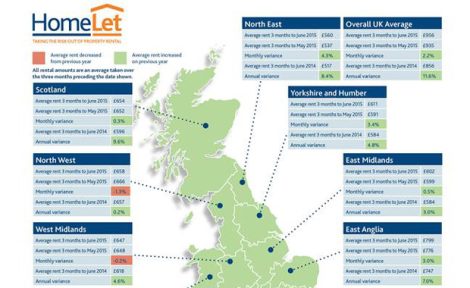
Rental prices are continuing to rise across all regions of the UK, the latest findings from the HomeLet Rental Index reveal. This is the second month in succession and only the fourth time in history of the Index – previously in October 2014 and once in December 2010 – that rent prices in every region of the UK have increased simultaneously. The HomeLet Rental Index figures for June 2015 show that rent prices across the majority of the UK are rising. The average rent price across the UK (excluding London) now stands at £747 per month for the three months to June 2015, an increase of 7.8 per cent against the same period last year, when the average UK rent, excluding London, was £692 per month. The highest rents continue to be recorded in the capital, where the average rent on a new tenancy now stands at a record high of £1,515 per month, up 10.1 per cent compared to a year ago. This rise is owed party to the fact that a growing number of tenants are moving into London, according to the report. Wakefield, Coventry, Brighton and Nottingham were also identified as ‘hotspots’ where tenants new to the…
Read More » -
Housing Market

This is Generation Rent
Almost half of UK renters believe that they will never be in a position to buy their own home and that may be because so much of their income is now going towards paying rent, research shows. According to an independent survey for construction and regeneration company Keepmoat, 44 per cent of renters in the UK believe they will never own their own property with not being able to afford a deposit the most common reason for not getting on the property ladder. Dave Sheridan, Chief Executive of Keepmoat, said, “It’s clear that the amount of money first-time buyers need to raise for a deposit continues to stop many from getting on the property ladder.” High rents in relation to earnings may have a lot to do with the fact that many people now feel unable to save enough money for a deposit to buy a property. Rents in England, for instance, now stand at 47 per cent tenants’ average take-home pay, data from the latest English Housing Survey shows. In contrast, those who have secured a mortgage face repayments equal to 23 per cent, on average, of their earnings after tax. The comprehensive report also revealed that once housing…
Read More » -
Uncategorised

Rents rising nationwide
Rental prices are now increasing across all regions of the UK, new findings from the HomeLet Rental Index show. This is only the third time in the history of the Index –previously in October 2014 and once in December 2010 – that rent prices in every region of the UK have increased at the same time. The Index also reveals that the pace of growth in London has picked up again, after a period of slower growth, with average rents agreed on new tenancies in May 2015 exceeding £1,500 per month for the first time. Rents agreed on new tenancies across the UK in the three months to the end of May 2015 were 10.7 per cent higher than the same time last year, with the average now standing at £935 per month, or £738 excluding Greater London. The South West of England saw the largest increases, with average rent prices 13.6 per cent higher than a year ago. Scotland, (9.6 per cent), the South East of England (9.4 per cent) and Greater London (9.2 per cent) also advanced strongly. In Greater London, the average rent now stands at £1,472 for the three months to May 2015, however, when looking…
Read More » -
Housing Market

Labour plans for PRS would be disastrous – NLA
Labour’s plans to cap rents, ban letting agent fees, and restrict tax reliefs for landlords who do not keep properties to basic standards could have an adverse impact on the private rented sector (PRS), according to Richard Lambert, Chief Executive Officer at the National Landlords Association (NLA). While acknowledging that Labour has tenants’ “concerns at heart”, Lambert points out that the policy will almost certainly backfire because “they don’t understand the economics of supplying private housing to rent”. The NLA’s CEO (left) insists that these changes “will have far-reaching consequences for the PRS”, and could deter many people from investing in the buy-to-let market which in turn would reduce the supply of housing stock in the PRS. He commented, “If these proposals are going to be rushed into the first Queen’s Speech, less than a month away, without time to think through the consequences, Labour’s good intentions could make the housing crisis worse, not better.” NLA research has found that around two-thirds of landlords do not increase rents during a tenancy. Lambert continued, “Capping annual price rises to inflation sounds like a great consumer protection initiative, but wherever these formulas have been introduced, it’s proved to be counterproductive because it…
Read More » -
Housing Market

Ed’s last stand: “a load of cobblers”
General Elections bring out the opinions of the electorate and property people have been more than forthcoming in these last days before the big election day on 7th May. Naomi Heaton (left), CEO of London Central Portfolio says that Ed Miliband’s “last stand” is “a load of cobblers”. Among her points are: “The latest Labour pledge is to abolish stamp duty for first-time buyers buying homes worth up to £300,000 for the next three years. They have said that it will benefit nine in 10 such buyers to the tune of £5,000. Rubbish. “Labour is clearly very bad at its sums, which is why, of course, we are so worried about them running the economy. “The average purchase price for a first time buyer outside London is £137,120, (Halifax). Following the Stamp Duty reforms introduced by the Conservative coalition last December, the Stamp Duty charge for buyers at this level is just £242. This is what the Labour policy would save, not £5,000. “If we look at the country as a whole, including London, the average price for a first time buyer, is £171,870. Again, due to the recent reforms, Labour would be knocking off £937 off their purchase costs,…
Read More »