TOWN AND CITY TRACKER: Belfast boasts biggest house price rise
Kate Faulkner analyses the latest regional house price data, which shows prices rising year-on-year at roughly the pace of inflation.
The Land Registry data is showing some huge increases year-on-year, but I think this must be being skewed by the SDLT temporary reduction, rather than these rises being reflective of a huge boom.
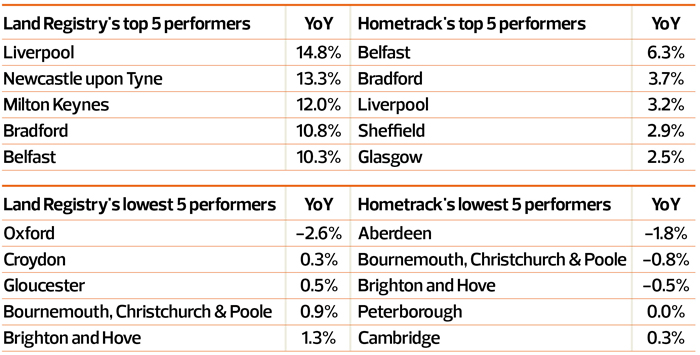
City house price performance – year-on-year
While headline figures show property prices rising year-on-year at roughly the pace of inflation, a critical detail often overlooked by the media and missing from official indices is this: among the 30 towns and cities tracked below, half still have average prices below their 2022 levels – before the market dip triggered by Liz Truss’s ill-fated mini-budget.
Land Registry data shows highly varied trends between cities, which appears to be distorted by the strong end to property prices in 2024, followed by the rush of transactions fuelled by the temporary Stamp Duty cut. Some variation between Land Registry and Hometrack is expected due to reporting lags, but the scale of disparity this month is too high to be relied on.
Seeing areas like Milton Keynes, Newcastle, Bradford and Liverpool showing annual price growth exceeding 10%, while most others are seeing just low single-digit increases, indicates that the additional volume we saw in Q1 2025 has led to the average price data for Land Registry at City level being skewed.
For now, Hometrack’s city-level tracking likely presents a more accurate and stable reflection of underlying market conditions than Land Registry’s price change data.
Property prices versus inflation over the long term
From Hometrack’s figures, only two cities are seeing property prices growth in excess of inflation and these include Belfast and Bradford, with Liverpool rising just under the 3.4% inflation rate increase recently reported. This means that ‘on average’ since 2022 property prices have not kept up with inflation (8% increase versus 10% inflation increase).
IMAGE
Appendix: City/town property indices price tracking
For city/town tracking, we use Land Registry (government data) and Zoopla/Hometrack. The Land Registry data is useful because we can analyse how property prices have changed over time and this helps us to put today’s price information into context.
The Zoopla/Hometrack data is useful as they take into account the change in mix of property transactions during the pandemic to houses away from flats. This has meant the likes of the Land Registry and other indices have over exaggerated price changes year on year.