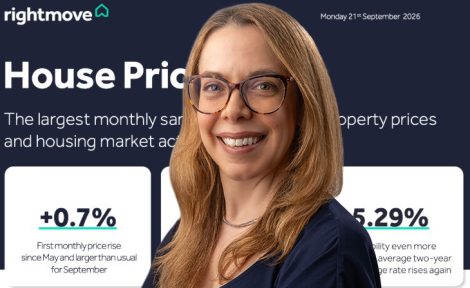
House prices hold firm in face of global headwinds, Rightmove data shows
Rising inflation fears and higher borrowing costs limiting growth in asking prices, says portal's property expert Colleen Babcock.
The housing market is holding steady despite global uncertainty and the increasing cost of finance, with buyers continuing to press ahead with their moves, according to Rightmove.
Colleen Babcock, Property Expert at Rightmove, says: “Some buyers will be feeling cautious due to cost of living and mortgage rate increases. However, the latest data shows that, at least for now, home-movers are largely showing their usual resilience with their housing needs trumping other events… the overall market currently remains resilient.”
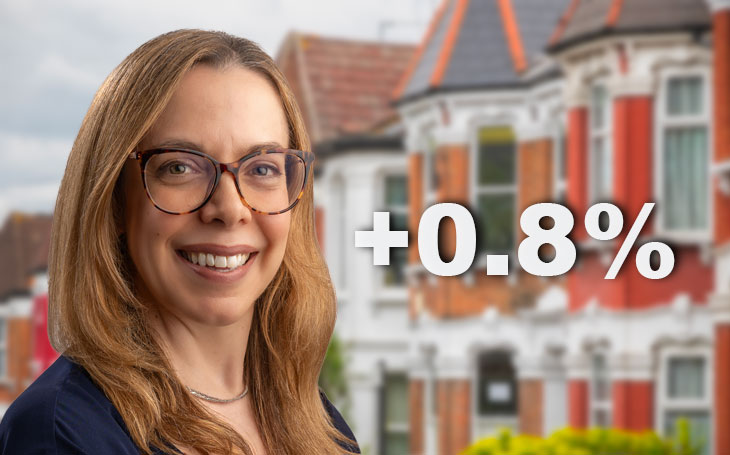
The average asking price of a newly listed home rose by 0.8%, the equivalent of £2,929. in April to £373,971, a smaller increase than the long-term average for this time of year.
While demand remains softer, down 7% on last year, the number of sales agreed is just 3% behind, with affordability being underpinned by wage growth at 3.9% and more flexible lending criteria.
At the same time, however, supply remains elevated, and mortgage prices are rising, limiting any potential for further growth in house prices.
Price growth is proving strongest in parts of the market less exposed to higher borrowing costs…”
Babcock says: “With mortgage rates remaining elevated due to the war in Iran, it’s not a surprise that price growth is proving strongest in parts of the market less exposed to higher borrowing costs…”
That shift is clearly visible in the data, with top-of-the-ladder homes seeing price growth of 2.4% this month, compared with just 0.2% for first-time buyers and 0.4% for second-steppers.
Industry reaction

Polly Ogden Duffy, Managing Director at John D Wood & Co, says pricing has become “more critical than ever”, with buyers less willing to engage with overpriced homes.
Jeremy Leaf, north London estate agent and a former RICS residential chairman, says: “There’s no question war in the Middle East has had an impact on property market activity with hostilities continuing but not as severe as feared.
“Although the Rightmove data reflects asking, rather than achieved, prices, steeper reductions might have been an early warning of tougher times ahead, bearing in mind worries over affordability and especially mortgage rates.

“However, in our offices, the negative effects have also been relatively limited to date, with the overwhelming majority of sales proceeding as well as new listings and buyer enquiries steady. On the other hand, the amount of choice of some property means prices remain flat and transaction times are lengthening. We have been involved in some fairly intense negotiations, too, with existing as well as new buyers and sellers trying to factor in anticipated increases in costs.
“Looking forward, we don’t expect much to change at least until the beginning of the end of the uncertainty is in sight, although even then, the after effects will inevitably linger.”

Marc von Grundherr, Director of Benham and Reeves, says: “What we’ve seen is not a collapse in confidence, but a more cautious and considered approach from both buyers and sellers.”

Tomer Aboody, Director at specialist lender MT Finance, says: “With mortgage rates fluctuating due to global affairs, along with lower economic uncertainty due to the Labour government, we are seeing a lower number of transactions but only slightly down compared with this time last year.

“With buyers having more options as more homes come to market, prices are still buoyant, although rising at a much slower pace. Buyers are slowly realising that the days of virtually “free money” are long gone, and that current rates are actually more or less in line with historical averages, give or take 100 basis points.”
Mark Wiggin, Director of Mark Wiggin Estate Agents, adds: “Deals are still getting done… What really matters right now is price.”