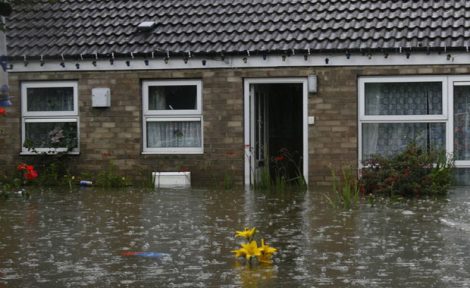
A river runs through it? The threats of a flood risk property
Alison Wacey, legal expert, examines a flood risk property owner’s rights and duties.
 Having a stream, brook or river through or abutting your land may seem idyllic, but it does bring with it responsibility for repair, maintenance and flood defence. Last winter, flooding hit extensive areas of Britain. Many people had their homes inundated, villages were cut off, farmers exasperated and the insurance bill is rocketing.
The good news is that you have a right to protect your property and are allowed to carry out your own flood defence work. Indeed, one of your duties is to be responsible for protection of your land from flooding. However, you will need permission for any operations from the relevant authority which will depend on the type of watercourse, but it is usually the Environment Agency.
There is no duty to improve the drainage capacity of a watercourse but you do have to accept flood flows, even if caused by inadequate capacity downstream.
And all this has to be in the context of your riparian rights and duties if you own a flood risk property.
Be warned – they are extensive.
RIGHTS AND RESPONSIBILITIES
The riparian principle dates back deep into common law.
In general, all landowners whose property adjoins a body of water have the right to make reasonable use of it as it flows through or over their property.
But there are widespread rules and restrictions.
If you own land that has a watercourse running through it, it is assumed that stretch of water is owned by you.
Where the boundary of your land is next to a watercourse it is assumed that you own the land covered by the water up to the centre of the stream, unless the title belongs to someone else.
You may need to check the deeds if there is a wall or hedge running alongside as to whether this defines your boundary or the watercourse.
The ownership of part of a watercourse brings with it both rights and responsibilities.
You have the right to fish but not to moor. The water in the watercourse must be allowed to flow through your land without being polluted or diverted, while others downstream have the right to receive the water so it may not be taken out without consent.
You will be responsible for keeping the watercourse banks clear of anything that could cause an obstruction including culverts, rubbish screens, weirs and mill gates and you are also responsible for the maintenance of the bank, and all trees and shrubs growing on it and your half of the bed of the watercourse.
You will also usually be responsible for ensuring and carrying out any works necessary to reduce bank erosion.
If the watercourse is backing up and flooding your land this may be because a culvert lower down has become obstructed or is too small to take the amount of water flowing down the watercourse. A culvert is an obstruction to the natural flow of the water. You have a right of action against the owner of the culvert to have it cleared or enlarged.
DEVELOPMENT
Any proposed development that would obstruct the waterway needs Environment Agency consent. Any work on or near a watercourse will also need consent of the local authority and the appropriate risk management agency which will vary depending on the types of watercourse.
You may need to include a Water Framework Directive compliance assessment and this and other environmental factors such as flood risk, wildlife conservation and fisheries will be taken into account before consent is given to the works.
Also remember that the risk management authority, usually the Environment Agency also has statutory powers of entry onto your land for the purpose of carrying out any flood risk management work which includes maintenance and anything else they deem necessary. Complicated, isn’t it?
FISH AND ALIENS
You have a right to fish in the watercourse. This right may be sold or leased, and a fisherman must have a valid Environment Agency rod licence. Other duties take
in ensuring the free passage of fish and controlling invasive alien species such as Japanese knotweed.
THE RIVERSIDE IDYLL
In most circumstances that riverside cottage is an idyll, but you need to know your duties, your rights and, most importantly, possible drawbacks. If your house was knee deep in water while at the same time, unbeknown to you Japanese knotweed is ravaging your foundations, then this is not just a case of bad luck!
Estate agents should make buyers aware that there are responsibilities as well as rights with riverside homes.
 Alison Wacey is Residential Property Partner at Lodders Solicitors. www.lodders.co.uk