Will London soon be a skyscraper forest?
The original Tower of London looks like a bungalow now, next to its skyscraper neighbours and the trend is... even more of them.
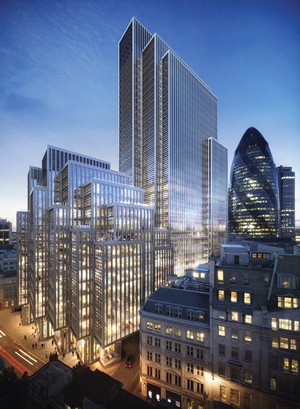 Did it start with the Gherkin? Or was it the Shard that kicked it off? When the trend really started rolling is difficult to decide, but right now, the skyscraper trend is transforming the London skyline – with residential towers, not just high-rise offices.
That’s a revolution for London, where the failure of the 1960s vision of ‘communities in the sky’ – in reality, cheaply built, faulty blocks that soon became sink estates – tainted the image of high-rise residential for decades.
Docklands started the change, but it’s only now that a 50 year prejudice in favour of low-rise residential development is being challenged by an increasing number of skyscrapers across the capital. At least 200 new towers are planned in London, over 150 of them are residential – no wonder Knight Frank refers to “London’s burgeoning residential tower sector.” In fact that could be an underestimate. A survey by the New London Architecture thinktank suggests that 236 buildings over 20 storeys could be on the way, 189 of which are intended to be residential. That’s 80 per cent, and it’s unprecedented – apart from public sector housing at the Barbican and a couple of other estates, look at London high-rise from the Post Office Tower to the Shard, it was all office use.
TALL STOREYS

The number of towers actually being built is a bit smaller; Susan Emmett, Director of Residential Research at Savills, says there are 31 buildings between 20 and 40 storeys under construction in London, and six over 40 storeys high. But, she says, that’s just the tip of the iceberg; “More are coming – 41 buildings of 20 – 40 storeys have received consent, subject to Section 106 agreements, 15 between 40 and 60 storeys, and three over 60.” That’s another 59 buildings. And there are more still in the planning process.
Not every residential tower will get planning permission, of course. But planners are increasingly tower-friendly, particularly in the City – perhaps because the authorities in the Square Mile feared losing out to the soaring spires of Canary Wharf. Clusters of high-rise residential buildings are emerging, generally in what have been peripheral areas such as the South Bank, Nine Elms and City Road, Islington. There’s also a Docklands cluster around Canary Wharf – hardly a surprise.
HOMES IN HIGH PLACES
Susan Emmett says the greatest concentration of consented towers over 20 storeys coming through is to the East of London, from Tower Hamlets to the Isle of Dogs and, on the south side of the river, the Greenwich peninsula. “Of all London’s Local Authorities,” she says, “Newham will see the largest number of tall buildings emerge over the coming years.” But Wandsworth and North Lambeth aren’t far behind – a south- western cluster matching the eastern one. Lisa Hollands, MD at CBRE, says that the south bank from Battersea to Tower Bridge “is one of the most exciting patches of new development in London.” She notes how the architectural design of riverside properties has changed from the wharf and warehouse refurbishments of the 1980s and 1990s to shining modern buildings, and in particular high-rise; “The quantum and quality is unprecedented,” she claims, “and will completely change the London skyline.”
Some of the new towers are fairly plain. But many have adopted bizarre shapes, like the Strata, completed in 2010, with its Gillette razor looks, following the success of walkie talkies, shards, pinnacles, and cheesegraters as patterns. The Baltimore Tower in Canary Wharf, for instance, has a spirally twisting circular design, while Herzog & De Meuron architects have designed a white circular tower at Wood Wharf which uses balconies to create a reticulated, textured effect. Finishes in glass and chrome, as well, try to avoid the concrete jungle connotations of the brutalist slab skyscrapers of the 1960s.
HIGH RISE COSTS
High rise is now even seen as regenerative, in areas such as the South Bank and Nine Elms. The Shard, for instance, will be the centrepiece of a new urban area, intended to clean up the messy and chaotic approaches to London Bridge station.
However, high-rise is also high cost. Research from Knight Frank points out the economics are not linear – once you get past 20 storeys, costs per square metre rise fast. The building structure and technology is more expensive than for lower buildings, and logistics is a major constraint and cost. For instance, workers take longer to get to their workplace when it’s on the 50th floor – that’s one reason why building up there is 43 per cent more costly than on the tenth floor. (Slender towers also use space less efficiently than wider, lower buildings, since the larger service core space required decreases the ratio of net to gross space. Against this you have to set a much more efficient use of land, which does have advantages in the pricy London market.
Financing towers is a bit trickier than financing low-rise projects, too. The financing structure is more capital intensive; phased development is not really an option, though within a mixed use developments, residential towers are sometimes started towards the final stage of a larger overall scheme. That makes such developments viable only when buyers are willing to buy off-plan, a factor that might explain why it’s now, with the UK housing market booming, that high-rise is taking off. At the moment, property consultancy CBRE says, London off-plan sales are hitting 60 per cent of all sales of new property, which obviously makes life easier for high- rise developments.
It also explains why a number of developers are hedging their bets by creating mixed-use towers. For instance, One Nine Elms will feature a five-star hotel and retail space, as well as 436 apartments.
It’s also interesting that UK banks don’t seem to be interested in this sector of the market. Most developments have been financed by foreign funds or developers. For instance the Qatari sovereign wealth fund is now working on a residential tower next to the Shard, while Hong Kong based Hutchison Whampoa is financing three forty-storey towers at Conroys Wharf, Deptford – a far south-eastern outlier – and another Chinese investor, Dalian Wanda Group, is backing the high-rise development at One Nine Elms.
LAND FILL
Obviously, high-rise developments are a more efficient use of London’s scarce land resources than, say, another five or six storey apartment block. London has a major housing shortage; Susan Emmett says that the city needs to build over 50,000 homes a year in the next five years, but only 28,500 are planned. “London’s skyline is changing as demand for more homes grows,” she says; “We need to build at higher densities to provide much needed housing for our growing population.” Knight Frank too finds it “unsurprising” that “residential towers are increasingly seen as a way to boost the supply of homes in London.” So could high-rise solve London’s housing shortage?
One of the difficulties is the relatively high cost base of high-rise development. Knight Frank admits that tall towers can only be financed if buyers are prepared to pay base prices of £800-1,000 a square foot. That may not be high for central London (though it’s above the £715 / psq estimated by CBRE), but it’s towards the top end of the range for some of the outlying markets. Most tower developments have focused on the top end of the market, particularly on the upper floors – and they can do so because, as Knight Frank’s “Tall Towers” report in 2012 noted, “There is real demand for apartments offering a slice of ‘luxury’ London and unrivalled views across the capital.”
On the south bank, for instance, riverside tower developments are breaking the £2,000 a square foot barrier, against an average of £1,300 a square foot for the area, according to Lisa Hollands.
RISING DEMAND
There’s been a particularly high supply of flats in the super-luxury segment, for instance at the Shard, where flats have price tags as high as £50m, and at One St George Wharf where a 3 bed flat is on the market at £4.3m with Thackerays, and another (lower, but river-facing) 3 bed for £2.3m with Prime London. What’s intriguing is that these are prime prices, but not in traditionally prime areas; developers are relying on the attractions of high-rise to push prices above the average for the areas where they are developing.
This seems to reflect London trends as a whole – and the fact that market appears to be swinging to ever more upmarket properties isn’t just based on anecdotal evidence or high profile projects; CBRE has the figures to prove it. It estimates sales in the over £1,000 segment of the market increased 50% in Q4 2013, against a prime London sales increase of 10% (and a total London volume increase of only 7%).
Foreign buyers have been particularly keen on high-rise – perhaps more accustomed to aerial living than more feet-on-the-ground Brits. Half the 200 flats in the Heron building, Bishopsgate, went to foreign investors. Lisa Dean, research and forecasting guru at Colliers, says “Chinese and other Asian buyers have tended to focus on the prime residential areas… in upper price bands and in new build high- rise flats along the river Thames.”
So it seems that though high-rise may mean higher densities, it doesn’t mean more homes for average Londoners. Requirements for affordable housing have, apparently, been relaxed. At the Strata, 25% of the flats were reserved for affordable housing, though those were at the lower, less attractive levels, sectioned off from the rest of the building. That was back in 2010; there’s even less available now.
SELLING SUCCESS
There’s no doubt that high rise is selling, though. That even includes older properties – Erno Goldfinger’s Trellick Tower, listed in 1998 and subsequently restored, now sees its ex-council 2 bedroom flats selling for £400,000 plus. The Strata, marooned in unfashionable Elephant & Castle, still managed to generate excellent sales from plan, and more recently St George’s Wharf in Vauxhall achieved significant levels of off-plan sales. That was based on extensive marketing abroad – roadshows were held in Russia, Asia, and the Middle East – as well as in London.
Canaletto, in City Road, Islington, managed to sell over 50 per cent of its properties by February, though it was only launched in October 2013. Studio flats here cost £525,000, and one bed flats £720,000 and upwards. Like other high-rise developments, it’s not perhaps located in the sexiest area – City Road has never been as sought after as Angel or the Islington garden squares – but it’s gained by being sandwiched between the King’s Cross mega development and ‘Silicon Roundabout.’
There seems to be only one exception to the rule, and that’s the Shard. Depending on who you listen to, the super-luxury flats in the Shard have not actually been marketed yet – or have failed completely to sell. It’s fair to say that selling some of the highest priced flats in London in a relatively downbeat location could be considered a tough mission.
NO GUNG-HO
However, the commercial property sector provides a warning that perhaps we shouldn’t get too gung-ho about all this high-rise construction.
Although at the moment it’s doing well, many of the most prominent building sites were mothballed after the credit crunch struck, and it’s only now – six years after the credit crunch and the crash in commercial property values – that the Cheesegrater and the Walkie-Talkie are restarting construction, with the Pinnacle also rumoured to be restarting soon. The same economics that make luxury towers a highly profitable development at the moment could easily swing into reverse if the UK market were to turn down for any reason.

Naomi Heaton, CEO of London Central Portfolio (LCP), which has just launched its fourth investment fund, is wary of high-rise, as she’s cautious about new build properties in general.She notes that the average price of a central London new build in 2013 reached £1.69m – a £260,000 (18 per cent) premium over comparable resale properties. (CBRE puts the south bank premium even higher, at 25 per cent.) Looking at investment potential, she says, “chronic oversupply results in dramatically suppressed yields and prices,” which is exacerbated when looking at areas of the capital where there’s still significant potential for further development – exactly where most of the high-rises are going up.
“Canary Wharf, for example, has seen 30,000 new units developed since 2000 – in stark contrast to the 500 or so units a year in Prime Central London,” she says. Potential oversupply together with the possibility that foreign, particularly Asian, buyers may move on to other markets make the new properties a risk compared to, say, refurbished properties in traditional prime locations.
But in the meantime, the skyline of London is still changing – and looks as if it could change even faster in future.