A question of property: Paul Owen
Paul is one of the UK’s leading sales trainers and regularly works with property firms. Nigel Lewis talks to him about his new book – Secret Skill Hidden Career – and his thoughts on the UK estate agency industry.
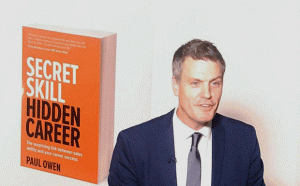 Secret Skills Hidden Career is based on a course that Paul has been running for several years which examines and shatters the myths of what a good sales person should be.
Paul also backs up his own thought with contributions from over ten of the UK’s most high-flying business leaders including Chris Townsend, Commercial Director of the 2012 London Olympics, and Chris Brindley, the MD of Metrobank.
Are estate agent unique in the way they sell?
In property you’re selling a service not really a product, but like any sales job in any industry you are still doing that basic thing; working out what the customer’s needs or desires are whether they recognise them or not, and then matching your service to them.
I think what estate agents tend to do is to get lost in selling the house or apartment rather than concentrating what makes their agency better to their competitor next door. If you sat a load of estate agents down in a room and asked them what they sell, they’d say property – but I would say that you don’t sell property, you sell a service.
It is to the cost of the agent that they are not talking enough about what is different about what they do. Not enough talk about that difference in any meaningful way.
If there’s one thing agents should do differently, what would it be?
Too many leaders in the sector don’t treat their sales people as the ‘gods of their business’ and instead, figuratively-speaking, beat them up too much about sales targets.
I recently did some training with a property firm in Bournemouth and one of the clearest messages from their sales team was that they responded best when they were told how well they were doing. Don’t beat up your sales people – the clients will do that for you without you doing it.
Who is the book aimed at?
It’s meant to be a useful guide for anyone starting any job so I guess people aged from 18 to 25 years old, although obviously it may appeal more to those who want to develop the sales side of their skills.
You mean Millennials – who are famously needy, right?
Every generation thinks the next generation are wasters and scoundrels but I do think there is an element of truth there. I believe parents have become so accommodating to their children’s wishes – and I speak as one – that they can lack that element of get up and go.
One of the chapters in your book concentrates on resilience – do they lack it then?
Well, I think resilience is importance because you need it when things are not going your way. But for a while now there has been a culture that leads people leaving school or university to believe they are going to get ‘amazing jobs’ without having to try too hard.
Do young sales people start work equipped well enough to succeed?
Education still doesn’t really teach you the skills needed to equip yourself for a life in business. One of the people I interviewed for the book – entrepreneur Lara Morgan – said she thought sales training should be part of the school and university experience, and I agree.
Selling is hardly ever mentioned in the press in a positive way – even though probably 10% of the working population do it, and it’s usually the largest function in any business, and particularly so in property.
Has the internet changed sales?
To me sales is broadly a business conversation that’s done face to face while everything else is marketing, but social media has blurred that – a Twitter account isn’t just about brand message, it’s also about directly talking with people via a computer.
Order Paul’s book here.