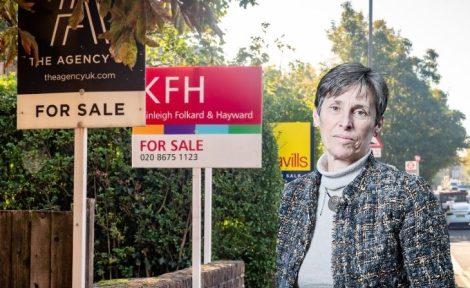
House price growth halves amid subdued property market
The latest Nationwide House Price Index shows a September slump in the housing market, says Robert Gardner.

The annual growth in average house prices halved in September to 0.8%, the latest Nationwide House Price index shows.
It marks the weakest rate of growth since December 2025.
The lender said average house prices also dropped by 0.2% on a monthly basis to £274,251. Overall, England saw annual price growth slow to 0.5%.
Average prices in northern England, comprising North, North West, Yorkshire & The Humber, East Midlands and West Midlands, were up 1.6% year on year.
Market activity and house prices have remained subdued in recent months.”
The North West, which includes areas such as Cheshire, Lancashire & Greater Manchester, remained the top performing region in England, with prices up 3.9% year on year, unchanged from the previous quarter.
Northern Ireland remained best performing region, with prices up 5.9% year on year in the third quarter of 2026. Meanwhile, Scotland saw an 1.2% annual increase.
Meanwhile,East Anglia was the weakest performing region, posting an annual decline of 0.7% on average.
Robert Gardner, Nationwide’s Chief Economist, says “Market activity and house prices have remained subdued in recent months, in part reflecting the uncertain economic backdrop.
“Geopolitical tensions remain high, with the conflict in the Middle East exerting upward pressure on energy prices, fanning inflation concerns. This in turn has led to mounting financial market expectations of Bank Rate increases, which has maintained upward pressure on the market interest rates which underpin mortgage pricing.
“Nevertheless, there have been encouraging signs that higher energy prices are not feeding through to underlying price pressures. In particular, private sector wage growth has remained modest, which should give policymakers breathing space to assess the extent to which tighter policy is necessary to ensure inflation returns sustainably to target.
“Underlying affordability is improving, as house price growth has been well below earnings growth for some time. These gains have been only partially offset by higher mortgage rates. This suggests that activity should regain momentum in the quarters ahead providing the energy shock fades and confidence returns – especially if market interest rates fall back to pre-conflict levels.”
Market reaction

Nicky Stevenson, Managing Director of Fine & Country, says: “Nationwide’s latest figures underline just how finely balanced the housing market remains. This is a market where buyers have more choice, and that means competition between sellers is particularly strong.
“While autumn typically brings a fresh wave of activity as people return to their routines and revisit moving plans, many buyers are still sitting tight for the time being. There are signs of buyers re-engaging, with home searches now 7% higher than a year ago, but buyers remain cautious and have little reason to overpay when there is so much choice available.
“Late August and early September often bring a fresh round of asking-price reductions as sellers recalibrate, and this year that adjustment looks particularly important. Sellers who price realistically from day one will be best placed to convert any renewed interest into viewings and offers. In a market where buyers can afford to be selective, overpricing risks leaving a property behind the competition rather than creating the momentum seller are looking for.”

Jason Tebb, President of OnTheMarket, says: “The dip in annual house price growth suggests price sensitivity as focused, needs-based buyers and sellers returned from holiday determined to get on with their moves before the end of the year.
“The national average figures conceal significant local variations, much depending on the type of property being bought and where it is located in the country – as always, the guidance of a knowledgeable local agent can be extremely helpful to those looking to transact.
“Market resilience is still in evidence, despite higher mortgage costs sounding a note of caution. The Bank of England’s decision to hold interest rates so far this year has helped in terms of affordability, but there are fears that rising energy bills may finally force its hand this autumn, depending on overall inflation risks.
“All eyes will be on the Budget later this month to see what the new Prime Minister and Chancellor have planned. We already know that there will be assistance for first-time buyers buying new-build homes and hope that on balance the budget provides some much-needed impetus for the housing market, as well as the wider economy.”

Iain McKenzie, Chief Executive of The Guild of Property Professionals, says: “September’s slowdown in house price growth to 0.8% is another indication that economic headwinds are continuing to pump the brakes on the market.
“The autumn normally provides a natural boost to activity, but this year elements such as elevated borrowing costs are making that recovery more difficult. Swap rates have risen and some lenders have responded by increasing mortgage rates, putting further pressure on purchasing power. Net mortgage approvals for house purchase also fell to 54,900 in August, below the previous six-month average.
“That said, there are encouraging signs beneath the headline figures. Home searches are now 7% higher than a year ago, suggesting buyers are re-engaging with the market even if some are not yet ready to commit.
“With inflation still elevated and borrowing costs continuing to weigh on affordability, more buyers and sellers may choose to sit tight. The autumn market is therefore likely to be characterised by genuine demand, but also a high degree of caution, with affordability and pricing continuing to determine whether interest translates into transactions.”

Nathan Emerson, Chief Executive at Propertymark, says: “As the economy continues to face periods of uncertainty and fluctuation, it is sadly unsurprising that the effects are increasingly being felt across the housing market. Many consumers are taking a more cautious approach to their household finances, with affordability pressures continuing to influence decisions around buying and selling property.
“With the Autumn Budget now only weeks away, there will be close attention on whether the UK Government introduces measures that can provide greater certainty for those looking to buy or sell.
“Support to help first-time buyers overcome the barriers to homeownership would be particularly welcome as we round the year off, while measures that encourage investment in housing will also be important to ensure the market is equipped to meet future demand.”

Tomer Aboody, founding director of specialist lender MT Finance, says: “Nationwide’s data points to a housing market which continues to soften.
“With the prospect of more taxation on the way in the budget, understandably buyers and sellers are reluctant to make a move unless it is essential.
“We already know about the While other political parties have proposed cutting stamp duty, and some have even mooted the prospect of getting rid of it altogether, will the government respond with something similar to get the property market moving? It would be a step in the right direction and give the economy a real boost this autumn.”

Jeremy Leaf, north London estate agent and a former RICS residential chairman, says: “Higher borrowing costs and inflation, as well as plenty of choice with the prospect of more to come, are compromising confidence in an already-nervous market. That is to say nothing of the impact of the budget as the date looms larger.
“The result is buyers are negotiating harder, especially for flats, to build in sufficient headroom to weather any further financial storms.
“The good news is that demand has slowly improved over the past three to four weeks so looking forward we expect more activity although already protracted transactions are unlikely to shorten any time soon.”