PROPERTY MARKET UPDATE: Divided by affordability, property type and location
Kate Faulkner reviews the latest indices, which reveal significant differences in the property market, while buyers and sellers remain locked in a stand-off.
 The latest figures show a market that remains subdued, but they also highlight why national averages can disguise what is happening at an individual property and buyer level.
This month, rather than report on nationally averages, due to the huge differences between buyers affordability and circumstances and different property types, here are the changes reported by Rightmove and Zoopla.
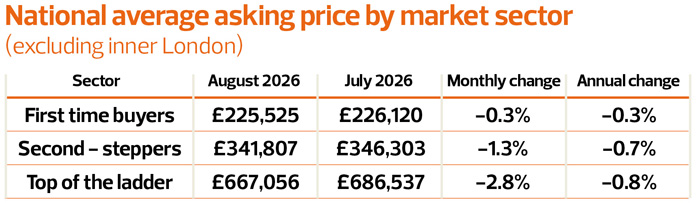
This shows how ridiculous reporting average prices is with such huge differences between what different buyers can afford. And it’s perhaps a bit of surprise that year on year the changes in price aren’t that different – from 0.3% falls for FTBs to 0.8% for those at the top of the ladder.
From a property type perspective, the difference is a bit more stark.
 Summary of the latest property market indices headlines
The individual indices reinforce this picture, with subdued price growth, affordability pressures and significant differences between regions continuing to shape the market.
Rightmove – Largest August price drop since 2018 despite mini bounce in buyer demand
– The average asking price of a newly-listed property dropped by 2.0% (-£7,360) this month, a much larger drop than we’d usually see in August.
– Price growth for northern and southern regions of England are very different, with prices in the north of England up by 1.5% compared with August 2025.
– Since Andy Burnham became Prime Minister on July 20th, buyer demand has increased by 5%.
– The average two-year fixed mortgage rate is 5.09%, up from 4.95% last month.
Colleen Babcock, property expert at Rightmove, commented: “This month’s larger-than-normal price fall reflects the reality of a market where buyers have plenty of choice and sellers are having to work harder to stand out and attract them. They’re also competing with an unusual number of distractions which have been keeping the minds of some potential buyers occupied, namely the World Cup and the hot weather.
“The first half of 2026 has been more challenging than many predicted, with the unexpected war in Iran contributing to higher mortgage rates and greater uncertainty for buyers. While activity remains below last year’s levels, it’s encouraging that the number of sales being agreed in the first half of the year is in line with 2024.
“Pricing remains critical, and it’s remarkable that nearly three-quarters of homes that have sold so far this year have done so without needing an asking price reduction.”
Nationwide – House price growth remained subdued in July
– UK annual house price growth slowed to 1.8% in July, from 2.2% in June.
– House prices were up 0.1% month on month.
– Average time in a home is 14 years: 24 years for those owning outright and 5 years in private rented sector.
– Three quarters of moves were within same tenure type in 2024/25.
Commenting on the figures, Robert Gardner, Nationwide’s Chief Economist, said: “Market activity and house prices have remained soft in recent months, in part reflecting the uncertain economic backdrop. Geopolitical tensions remain high, with the conflict between Iran and the US again exerting upward pressure on energy prices and market interest rates in recent weeks. Financial market expectations for the future path of Bank Rate have been volatile, reflecting shifting views about the inflationary implications of events at home and abroad.
“Despite the ongoing risks from the latest energy price shock, the Monetary Policy Committee can take some comfort from the fact that consumer price inflation declined further in June. Signs that wage growth has continued to ease gives policymakers more breathing space to assess the extent to which tighter policy is necessary to ensure inflation returns to target.”
Lloyds – House prices stable in July despite renewed global uncertainty
– House prices stable in July (0.0%) , following a +0.2% rise in June.
– Average property price now £299, 253 compared with £29 9,396 in June.
– Annual growth of +0.1% is the slowest rate of house price inflation since November 2023.
– Northern Ireland continues to record the UK’s strongest annual growth at +7.4%.
Amanda Bryden, Head of Mortgages, Lloyds, said: “…average house prices have remained relatively stable for almost two years, moving within a narrow range over that period and sitting just +0.5% higher than they were in November 2024. That trend has persisted even as buyers and sellers have faced a more uncertain economic backdrop this year.
“Affordability remains a challenge for many would-be buyers and, following recent events in the Middle East, mortgage rates have edged higher again after easing earlier in the summer.
“Sensitivity to borrowing costs is reflected in the latest industry data, which show a modest increase in both mortgage approvals and completed transactions in June following a bigger dip in May. While housing demand remains broadly steady, activity continues to respond quickly to changes in mortgage rates.
“Looking ahead, we expect market activity and house prices to remain relatively stable over the remainder of the year. Developments will be shaped by both how mortgage rates respond to the outlook for inflation and wider household confidence.”
Zoopla – Buyer activity is beginning to recover after the summer slowdown
– Searches for homes are 7% higher than a year ago, their strongest annual increase for 12 months.
– Sales agreed remain 6% lower than last year, although the gap is beginning to close.
– Higher mortgage rates have reduced buyers’ purchasing power by 9% since January.
– UK house price growth has slowed to 0.9%, down from 1.3% in June.
– Prices are flat or falling across much of southern England, while northern markets continue to record stronger growth.
– Buyers have plenty of choice, with 5% more homes for sale than a year ago.
– Agents who lead realistic pricing conversations will be best placed to turn returning demand into instructions and sales.
Richard Donnell, Executive Director, Zoopla, commented: “Buyer activity is beginning to recover after the summer slowdown, with searches for homes now 7% higher than a year ago. But with sales agreed still down 6% and buyers’ purchasing power reduced by higher mortgage rates, accurate pricing and local expertise will be critical this autumn.”
Looking beyond headline prices
One further analysis offers a useful alternative way of looking at what is happening beneath the headline price figures.
Home.co.uk have always produced really good insightful information on the property market and over the summer they have just released a new version of their house price index and commentary.
This means we’ve had to ‘retire’ their statistics from our National Property Price tracking index as their methodology has changed, so we can use it to compare their reporting of property prices in the past. However, it’s really worth having a look at how they are reporting property measures as I think they’ve picked on some of the really features that aren’t always easy to track and follow.
Their latest report highlights the key measures they are now tracking and overall they are reporting that the current market isn’t correcting, it’s just that there continues to be a stand off between buyers and sellers which in their words mean: “This is not a price correction, it is a liquidity one. Sellers are holding their asking prices and the market is absorbing the difference in time.”
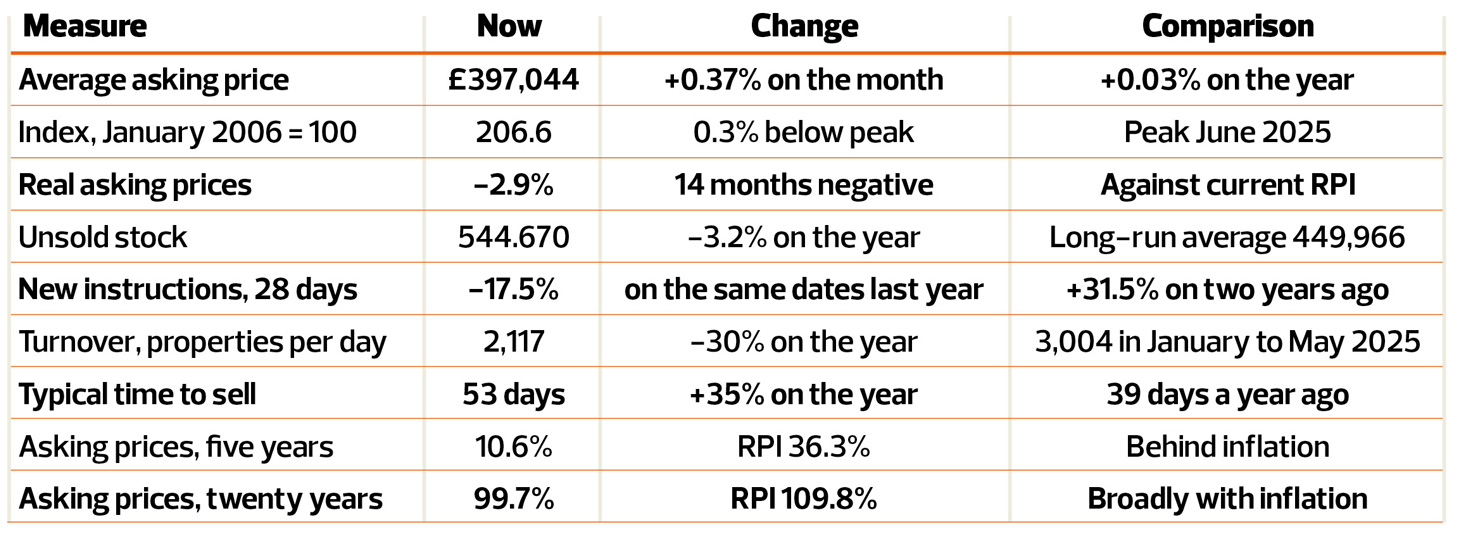 Which in summary means: “Asking prices are still creeping up in cash terms, but almost everything behind the price points the other way: fewer homes coming to market, far fewer leaving it, and a typical sale taking a third longer than it did a year ago.”
– Prices flat over the year
– Scotland leads, Greater London lags
– Turnover has dropped hard
– Down in real terms
– Fewer homes arriving
– A third longer to sell
This is a great read to secure a quick view of how the property market is performing as a whole, overtime, not just in nominal terms but in real terms too, which is a refreshing change from the media’s focus on average property prices.