ANALYSIS: House price growth remains modest despite summer distractions
Although momentum has been weakened by the heatwave, football and political changes, house price growth shows some resilience, reports Kate Faulkner.
 The latest property market data paints a picture of house price growth that continues to hold up despite economic uncertainty, but the headline figures only tell part of the story.
While prices remain broadly resilient, there are significant differences between regions and, increasingly, between the level of supply available to buyers and the demand from those looking to move.
Here’s a summary of the latest insights from the property market indices, followed by a closer look at what the supply and demand data is telling us.
Rightmove
Summer buyers distracted by sunshine, football and political change (July)
– The average asking price of newly-listed homes for sale drops by 1.0% (-£3,832) this month to £372,359.
– This price drop is more than we’d usually see in July (0.2% average over the past 10 years), as sellers try to tempt summer buyers distracted by the hot weather, World Cup and a change of Prime Minister.
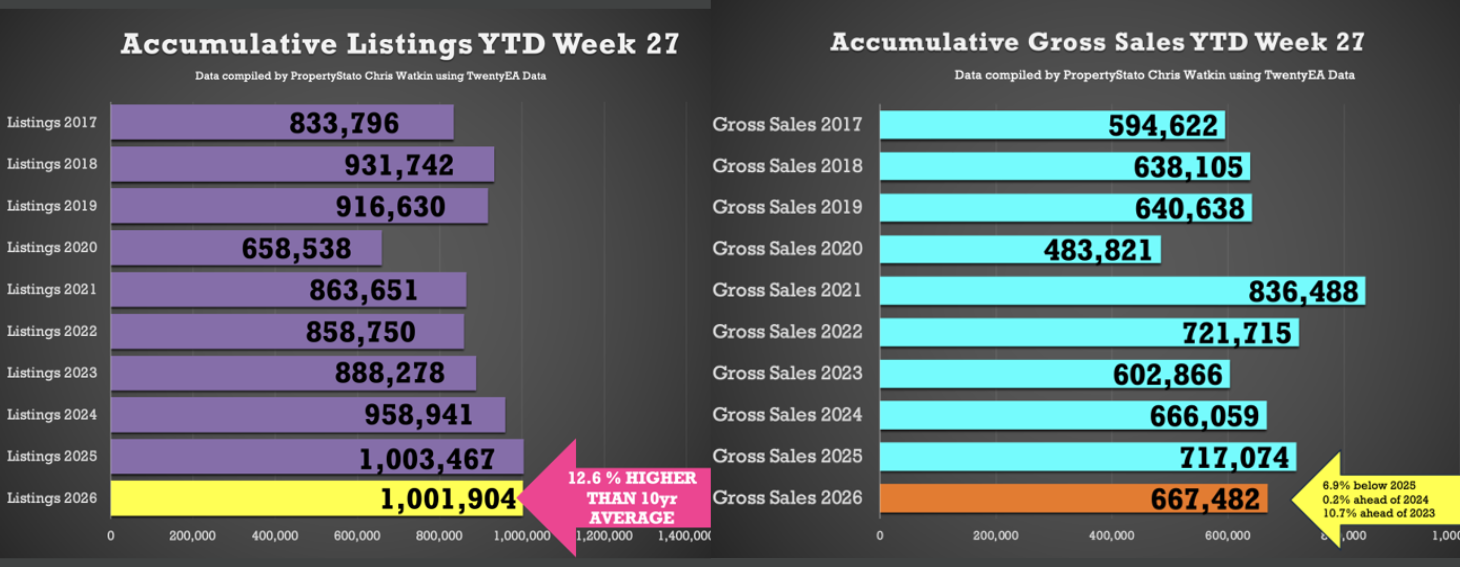
– Activity in the housing market is lower than it was this time last year (-6%) but level with the first half of 2024, showing that people are still buying when the property and price are right.
Colleen Babcock, property expert at Rightmove comments: “This month’s larger-than-normal price fall reflects the reality of a market where buyers have plenty of choice and sellers are having to work harder to stand out and attract them. They’re also competing with an unusual number of distractions which have been keeping the minds of some potential buyers occupied, namely the World Cup and the hot weather.
“The first half of 2026 has been more challenging than many predicted, with the unexpected war in Iran contributing to higher mortgage rates and greater uncertainty for buyers. While activity remains below last year’s levels, it’s encouraging that the number of sales being agreed in the first half of the year is in line with 2024.
“Pricing remains critical, and it’s remarkable that nearly three-quarters of homes that have sold so far this year have done so without needing an asking price reduction. A new Prime Minister also presents an opportunity to make housing a renewed priority, with action needed to support affordability, mobility and the delivery of more homes.”
Home
Regional gains broaden as London steadies (June)
– The mix-adjusted average asking price for England & Wales rose 0.4% over the month to £366,398. Annualised growth stands at 0.9%, up from around 0.5% at the start of the year, though it has eased back slightly from May’s 1.1%.
– Total unsold stock stands at 501,337 – up over the month, but 7.8% below a year ago – while new instructions are down around 17% year-on-year. Supply is tightening, helping to underpin prices.
– Asking prices rose month-on-month in every English region, Wales and Scotland. The more affordable markets continue to lead, consistent with stretched affordability steering demand northward.
– Greater London has halted its slide, with the annual rate now flat (0.0%) after a prolonged decline. The capital remains the laggard but is no longer dragging the national figure lower.
– The typical (median) time to sell holds at around 86 days. With stock elevated, a meaningful tail of over-ambitiously priced properties continues to linger well beyond the average.
– Annual growth is strongest in Wales (+3.3%), Scotland (+3.1%) and the North West (+2.7%). Greater London (0.0%) and the South East (+0.1%) bring up the rear.
– Average asking rents are broadly flat for England & Wales year-on-year (+0.2%) but with marked regional strength – the North East (+10.5%) and Wales (+11.9%) lead, while Yorkshire & the Humber (-1.3%) is the sole faller.
– With the Bank of England base rate at 3.75% and average fixed mortgage rates around 5.6–5.7%, borrowing costs have stabilised. Markets expect another hold at the 18 June MPC meeting, easing the rate anxiety that clouded the spring.
Nationwide
Annual house price growth edges higher in June (June)
– UK annual house price growth picked up to 2.2% in June, from 1.7% in May.
Robert Gardner, Nationwide’s Chief Economist, said: “It is not surprising that the market has softened a little in recent months, given the uncertainty caused by developments in the Middle East and the subsequent rise in energy prices and market interest rates. Indeed, consumer confidence and measures of housing sentiment have weakened, and mortgage approvals fell noticeably in May. “
“In recent weeks a shift in market expectations for the future path of Bank Rate has helped to bring down the market interest rates which underpin fixed-rate mortgage pricing.
“If maintained, these trends will help to restore household confidence and ease affordability constraints, paving the way for a recovery in housing market activity in the coming quarters, providing that domestic political uncertainty does not adversely impact sentiment.”
Lloyds
House prices edge up in June as borrowing costs start to ease (June)
– House prices rose +0.2% in June, following a -0.2% fall in May.
– Average property price now £299,330 compared with £298,812 in May.
– Annual growth up slightly to +0.6%, from +0.5% in May.
– Northern Ireland continues to record the UK’s strongest annual growth at +7.4%.
Amanda Bryden, Head of Mortgages at Lloyds, said: “Recent price trends continue to reflect wider economic uncertainty, including the impact of global events on inflation and interest rate expectations. While affordability remains stretched for many buyers, mortgage rates have eased from their recent high, offering some encouragement to those considering a move.
“Looking ahead, we expect the housing market to continue moving at a measured pace. Lower borrowing costs should provide some support for demand, though affordability constraints remain an important factor. The outlook for house prices will depend largely on inflation continuing to ease and household confidence gradually improving.”
Zoopla
UK house prices continue to show modest growth, up 1.4% year on year in June 2026
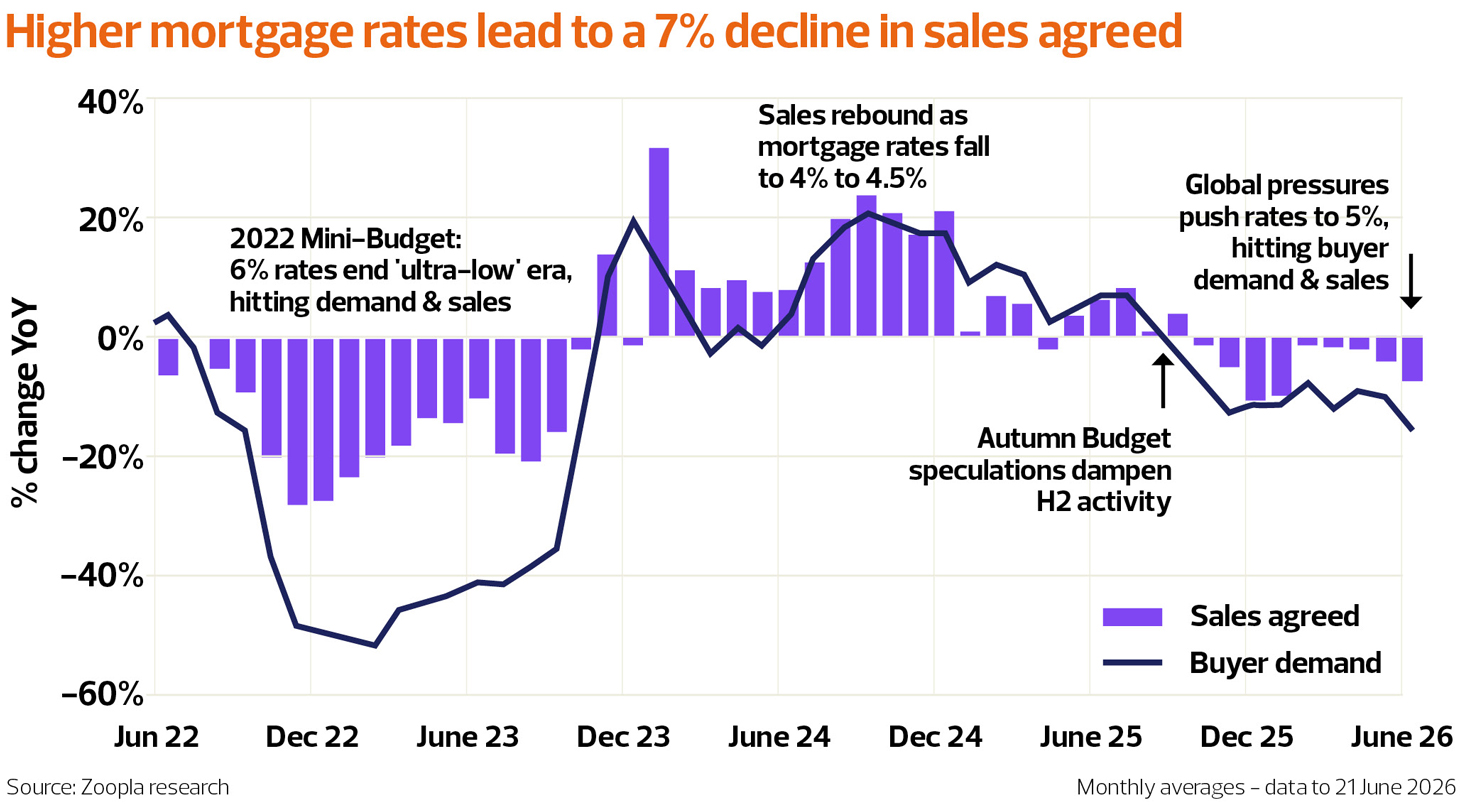
– Higher mortgage rates and political uncertainty have shrunk the pool of home buyers – sales agreed are 7% lower in June.
– House price inflation has edged lower to 1.4%.
– Mortgage rates peaked at 5% in April having started the year at 4% and are now falling. The cash cost for buyers varies widely.
– Mortgage costs are £244 a month higher in London but just £69 in the North East since January.
– Sales are down in across areas and house price inflation varies from 3.5% in northern England to small price falls in the south.
– We expect price inflation to drift lower in H2, while sales agreed are on track to be 6-8% lower than last year at 1.1m completions.
Supply and demand
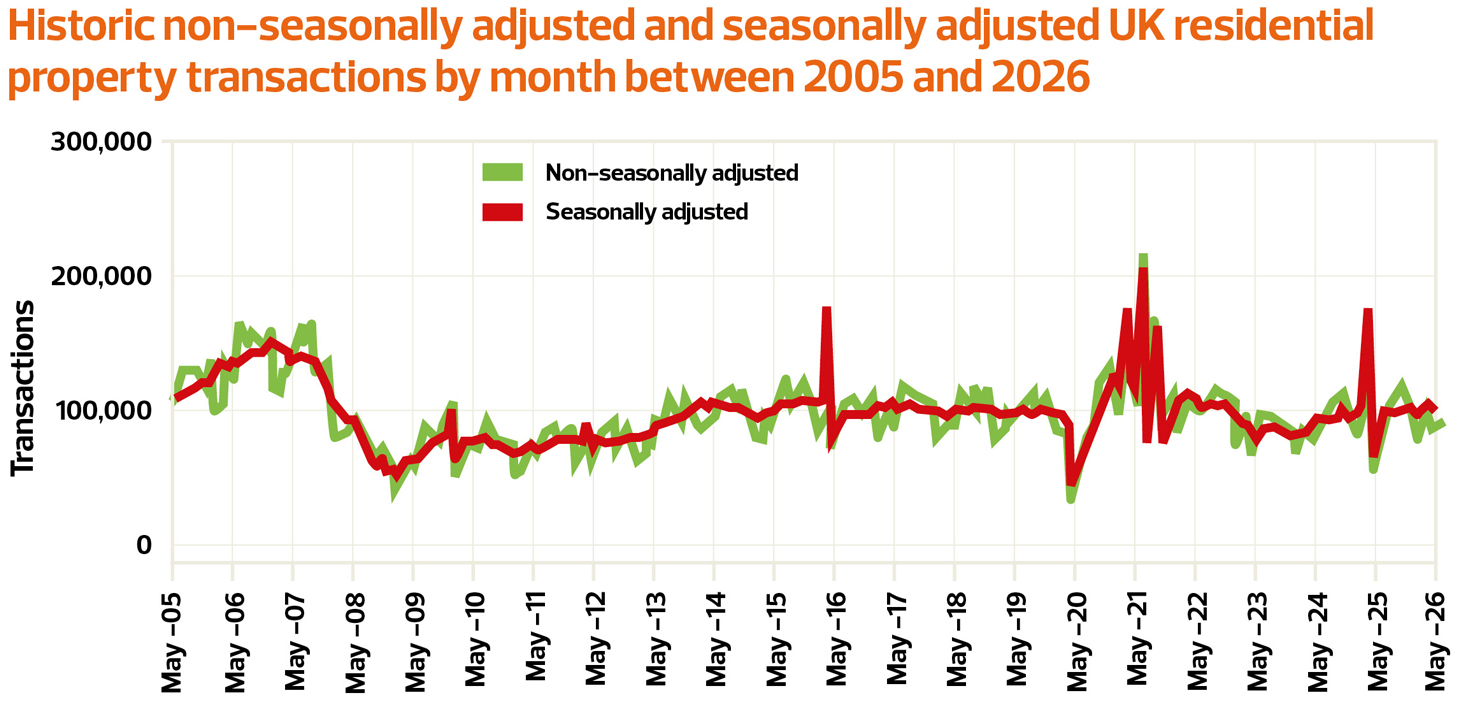
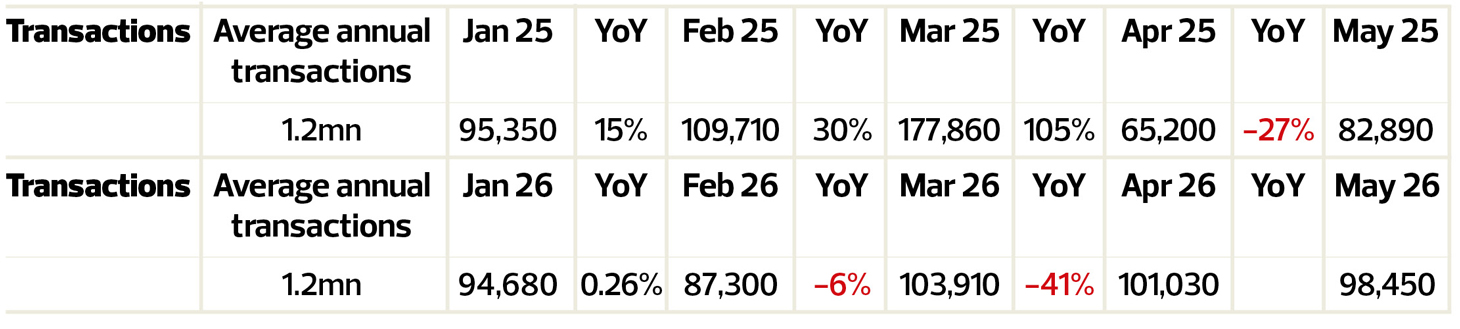
But while price growth remains relatively resilient, the latest supply and demand data highlights some of the pressures beneath the surface of the market.