Kate Faulkner’s house price analysis: towns and cities
Kate Faulkner focuses in on UK cities' house price performance according to the latest data from the leading market indices. How's your town faring?
 At city level, we have two main sources of data: Hometrack, which is around six weeks into the home buying and selling process and the Land Registry data, which is anything from a few months to six months or more out of date.
This means when prices are rising/falling, although still accurate from a historic perspective, the Land Registry data can report a fall when the actual market, now, is actually seeing a rise.
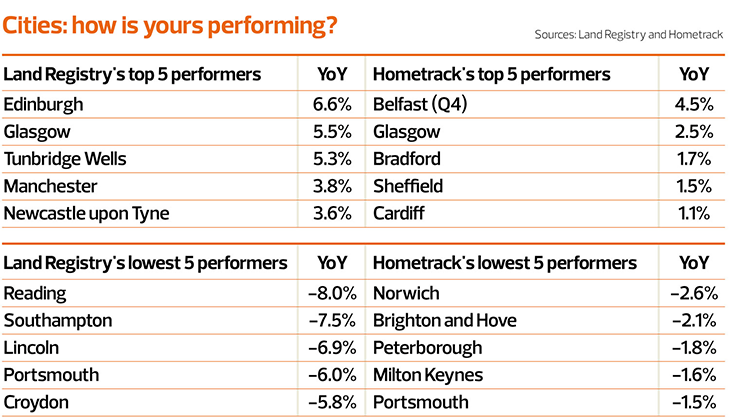
Of the highs and lows from the two indices, you can see below that they differ quite substantially this month, although the rises aren’t that diverse, while the Land Registry is still recording quite high falls of 8% in Reading and 7.5% in Southampton.
Topping the price growth charts according to Land Registry and Hometrack:
Out of the 30 cities we track via the Land Registry, since 2005, property prices have only risen above the average annual 3.8% inflation rate in five cities/towns. These include:
- Manchester
- Cambridge
- Bristol
- London
- Brighton and Hove
With the exception of Milton Keynes, where prices have risen at the same rate as inflation, the remaining towns and cities we track actually show that property prices, in many areas, have risen at less than inflation. In property, when you measure the market from and to, it can result in some very misleading information.
The following towns and cities price growth ‘on average’ are performing well below inflation:
- Newcastle upon Tyne
- Aberdeen
- Belfast
- Southampton
- Lincoln
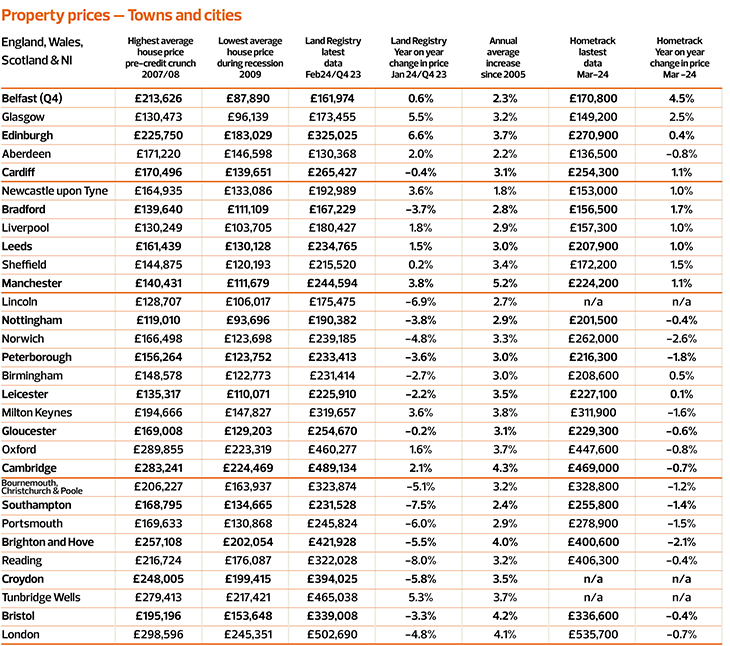
Appendix: City/town property indices price tracking
For city/town tracking, we use Land Registry (government data) and Zoopla/Hometrack. The Land Registry data is useful because we can analyse how property prices have changed over time and this helps us to put today’s price information into context.
The Zoopla/Hometrack data is useful as they take into account the change in mix of property transactions during the pandemic to houses away from flats. This has meant the likes of the Land Registry and other indices have over exaggerated price changes year on year.