PROPERTY MARKET UPDATE: Momentum slows but buyers gain ground
Property market expert, Kate Faulkner, examines slowing sales activity for sellers but improved affordability for buyers.
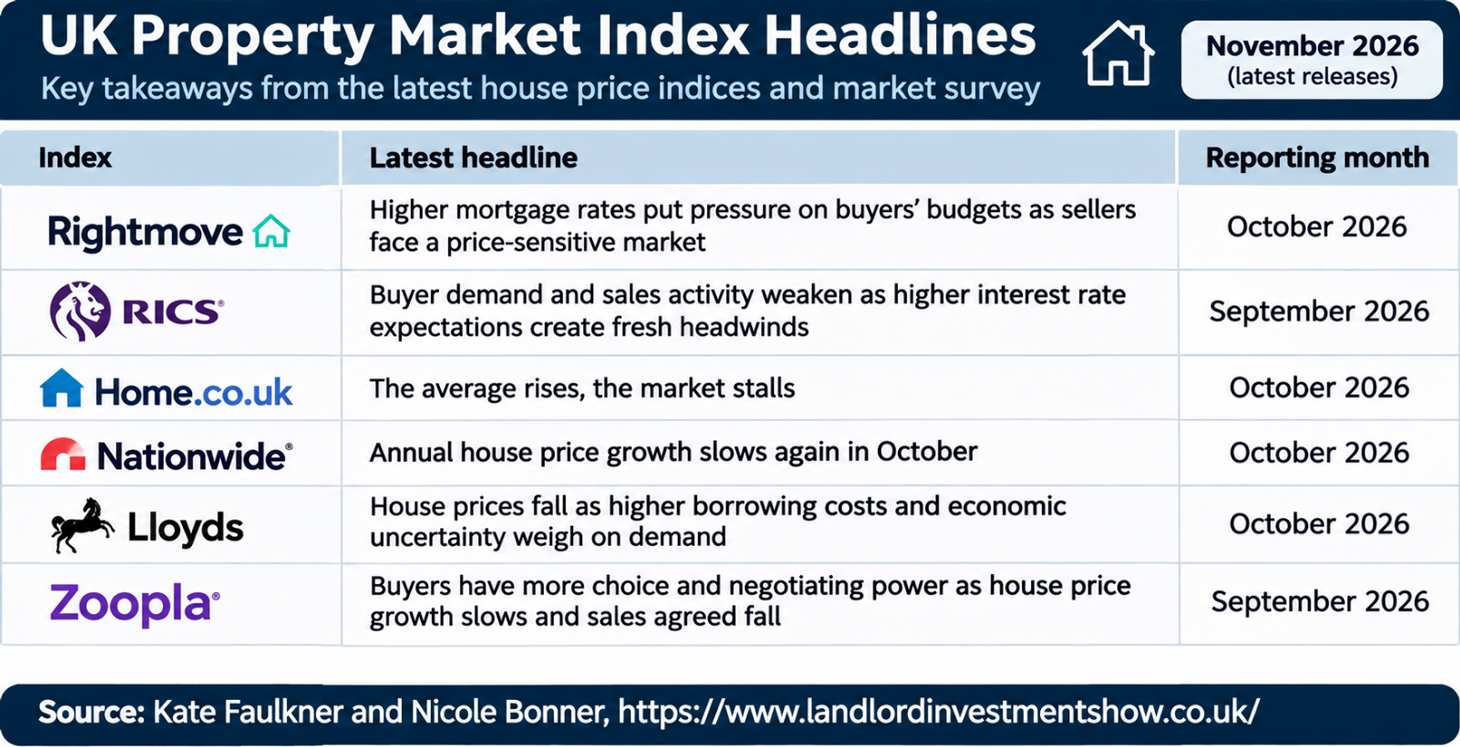
 The latest information from the main property market indices over the last few months suggests that house price growth and sales activity are slowing in many areas, as the headlines below show, with higher mortgage rates often being blamed.
As always, this means there are some ‘winners and losers’ in the property market at the moment. Sellers are having a tougher time and buyers are having one of the best times they’ve seen in while.
However, as we all now know, and thankfully the media are starting to catch up with, average house prices don’t really explain what’s happening in the market.
For example, averages hide the hugely different trends we’re seeing between flats and houses. At a local level, I’m also seeing quite a big difference between new build and older properties.
In the past, older properties often commanded a premium over new builds in many areas. Now, I’m seeing some amazing character properties with lovely gardens sitting on the market, while new builds locally (I’m on the borders of Nottinghamshire, Lincolnshire and Leicestershire) are almost flying off the shelves.
So, at the moment, I think the market might feel a bit doom and gloom, particularly if someones trying to sell, have made reductions but are still not finding that illusive one buyer they need to move on.
But the reality is that, up until recently, the property market (overall) has held up reasonably well, even with some areas/property types struggling as transactions are still not far off their long-term annual norm of around 1.2 million homes per year.
Some good news for affordability
However, there is some light at the end of the tunnel.
Firstly, E.surv has produced some useful data looking at how income growth since the pandemic has helped improve affordability relative to house prices.
According to Rob Owens, Head of Research: “Earnings pull ahead as house-price growth slows. Across every region of Great Britain, earnings have grown faster than house prices since 2023. That is a clear change from the longer period since 2019, when prices and earnings moved much more closely together.”
Of course, this is having a different impact across the UK because earnings, house prices and rents all vary enormously depending on where you live. Once again, it’s important to look beyond the averages.
Rob points out that: “London shows the widest gap. Median full-time earnings have grown at an annualised rate of just over 8% since 2023, while house prices have fallen by around 1% a year, leaving a gap of more than nine percentage points. The West Midlands, South West and South East also show sizeable gaps between earnings and house-price growth.”
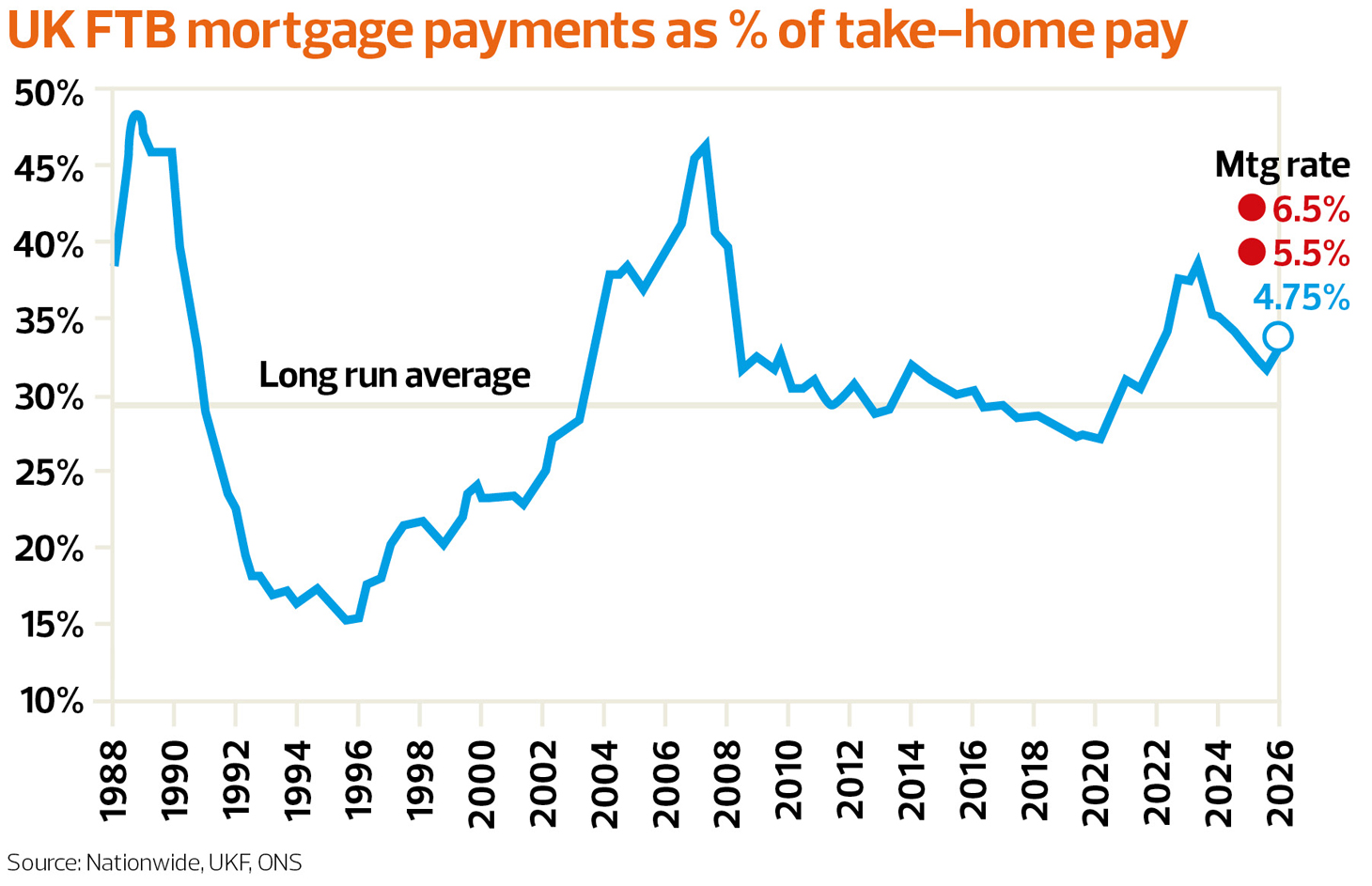
This is quite an important change, particularly when you consider what’s happened since mortgage rates started rising in 2022.
As the research explains: “House-price growth slowed as borrowing costs rose from 2022, while earnings continued to increase. By 2023, earnings were beginning to pull ahead of prices across every region. Stronger earnings relative to house prices improve buyers’ borrowing capacity, but higher mortgage rates pull in the opposite direction, keeping monthly borrowing costs well above the ultra-low-rate years.”
So, although wages have been catching up with house prices, higher mortgage rates mean that this improvement hasn’t necessarily translated into cheaper monthly mortgage payments.
We aren’t far off reaching the point where much of the impact of higher mortgage rates has been absorbed.
However, we aren’t far off reaching the point where much of the impact of higher mortgage rates has been absorbed. Although some people are still benefiting from the rock-bottom rates of below 3%, many of these deals will come to an end over the next year or so. And thanks to rising incomes, although some households may have to cut back on their spending to afford higher mortgage payments, it doesn’t necessarily mean they’ll be forced to sell.
The reality is that if, and when, we see mortgage rates fall back towards 4%, I think the property market could pick up quite quickly.
Boost for first-time-buyers
Secondly, of course, we have the new ‘Your First Home’ scheme, which should help first-time buyers who don’t have the support of the Bank of Mum and Dad.
Interestingly, some are suggesting that the scheme could actually cause first-time-buyers to hold off purchasing in the run-up to Christmas, as pre-registration won’t open until December and full applications aren’t due to open until February 2027 (with the first sales completing in April).
However, we know how much the previous Help to Buy scheme helped stimulate demand for new-build homes. Hopefully, this new scheme will have a similar effect, helping to boost next year’s sales figures and, more importantly, enabling more first-time buyers to get onto the property ladder.
After all, there are plenty of potential buyers who can afford the monthly mortgage payments but struggle to save the deposit needed to buy. If the scheme can help bridge that gap, it could make a real difference to those trying to buy their first home.
Summary of the latest property market indices headlines
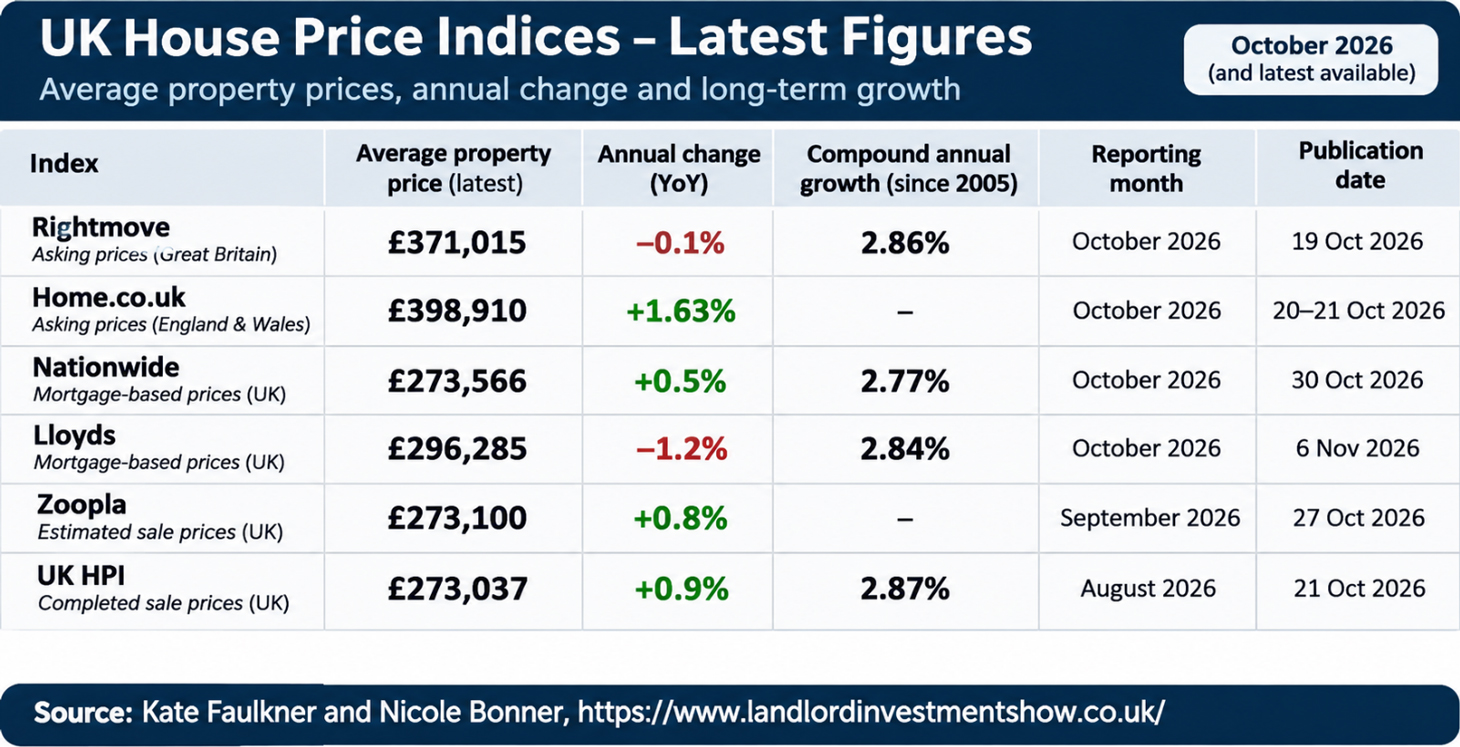
Rightmove – Signs that soaring mortgage rates are now biting harder
Colleen Babcock, property expert at Rightmove says: “The rapid rise in mortgage rates is really beginning to hit buyers’ budgets.”
Babcock explains that rising mortgage costs are now affecting asking prices even in previously more resilient, lower-priced markets. She stresses the importance of competitively pricing properties from the outset and taking local estate agents’ advice.
Matching index: £371,015 | −0.1% annually.
– New sellers in four of the five lowest-priced parts of Great Britain are reducing asking prices, including annual comparisons within the report’s latest monthly assessment showing falls of 2.0% in the North East and 1.9% in Scotland.
– Sales agreed are 8% below the same period last year, although Rightmove says transactions are continuing despite higher borrowing costs.
– The average two-year fixed mortgage rate increased to 5.55%, compared with 5.29% the previous month and 4.25% before the conflict in Iran.
– Higher mortgage rates have added approximately £250 a month to the cost of a typical new mortgage since February.
RICS – A renewed rise in interest rate expectations has created a fresh headwind for the housing market
RICS says that buyers are becoming more cautious and sales activity is losing momentum. However, the survey does not suggest a dramatic change in direction. Instead, it points towards a prolonged period of subdued activity as households adjust to potentially higher borrowing costs.
The survey reports a net balance of −22% for new buyer enquiries and −18% for agreed sales.
– National house prices still reportedly edging lower.
– New buyer enquiries indicator remains downbeat, with sales volume continuing to weaken against a challenging macroeconomic backdrop.
– Forward-looking measures revised down, with sales and prices expected to decline a little further over the next twelve months.
Home.co.uk – The average rises, the market stalls
Cheaper homes are selling and dearer ones are staying on the market, which lifts the average of what is left. In London, homes that sold averaged about £625,000, against £769,000 for new instructions.
– Once inflation is taken into account, asking prices are 1.8% lower than a year ago, continuing 17 consecutive months of negative real-terms growth.
– The number of unsold properties reached 559,948, an increase of 5.2% compared with October 2025.
– The typical time taken to find a buyer has increased to 57 days, compared with 29 days a year earlier.
Nationwide – Annual house price growth slows again in October
Robert Gardner, Nationwide’s Chief Economist, says: “Once the energy shock fades, there are good reasons to believe the market will regain momentum. The broader economy has proven surprisingly resilient to date, with annual economic growth accelerating in recent quarters. Employment is holding up well, as are real incomes, while household balance sheets are solid, with debt levels still close to 20-year lows relative to household disposable income.
“Moreover, the improvement in housing affordability seen over the past two years has been only partially unwound as a result of higher market interest rates, as income growth has continued to outpace house price growth by a wide margin.”
Matching index: £273,566 | +0.5% annually.
– UK annual house price growth slowed to 0.5% in October, compared with 0.8% in September.
– This is the weakest annual growth rate since January 2024.
– Nationwide highlights that household incomes have continued to grow faster than house prices, meaning the improvement in affordability over the past two years has only been partially reversed.
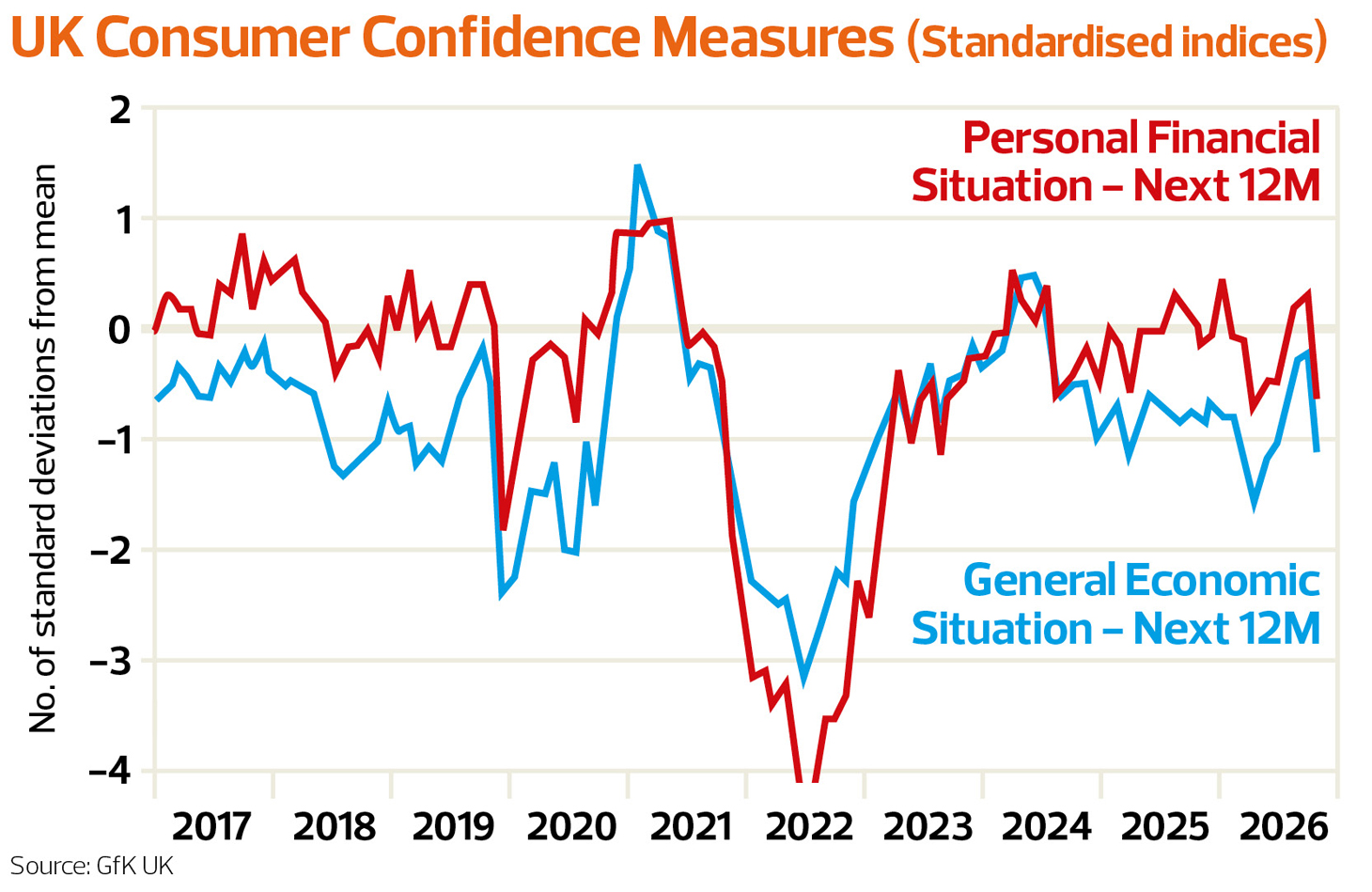
– Nationwide reports consumer sentiment dipped noticeably in October, with households becoming less confident about the outlook for the general economy as well as their own financial situation in the year ahead.
Lloyds – House prices fall in October as market remains subdued
Andrew Assam, Mortgages Director at Lloyds, says: “Housing demand is currently being tested by a challenging economic backdrop. Renewed inflationary pressures, driven in part by the conflict in the Middle East, are keeping borrowing costs high and adding to the squeeze on household finances, making some buyers understandably more cautious.
“However, it’s important to put October’s fall in context. House prices have changed relatively little over the past couple of years, as the market has gradually adjusted to higher interest rates. The recent rise in energy and other household costs have added to the pressure on buyers, so some adjustment in prices is not surprising.”
Matching index: £296,285 | −1.2% annually.
– House prices are 1.2% lower than a year ago, the largest annual decline since October 2023.
– Lloyds suggests that higher borrowing costs and economic uncertainty are making buyers more cautious, although it does not expect the latest decline necessarily to signal a sustained period of falling house prices.
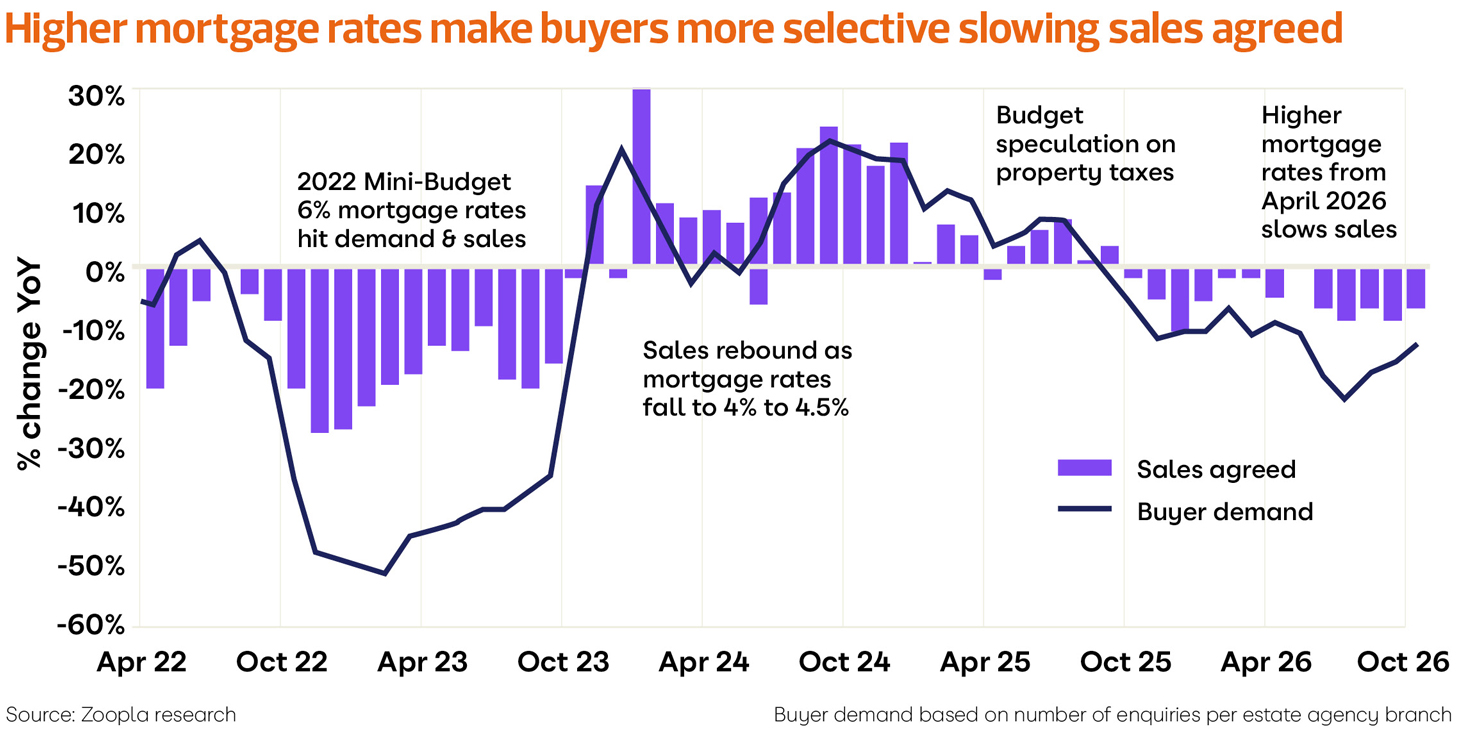
Zoopla – Buyers have more choice as higher mortgage rates slow sales
Richard Donnell, Executive Director – Research at Zoopla, says: “Buyers have more choice and room to negotiate.”
Matching index: £273,100 | +0.8% annually.
– Flats and maisonettes have experienced an annual price decline of 2%, while terraced properties have increased by 1.6% and semi-detached homes by 1.3%.
– The number of homes available for sale is 7% higher than a year ago.
– Sales agreed are 7% lower than the same period last year, as higher mortgage rates affect buying power.
– Homes that successfully sell are finding a buyer in an average of 44 days, broadly in line with a year ago.
– Buyers have more choice and greater negotiating power, particularly in southern England, where some local markets are experiencing falling prices.
What happens next?
It’s tough to work this out, partly because many of the problems affecting the economy and housing market are being driven by events outside our control.
Getting inflation back down will depend, in part, on what happens with the wars in Iran and Ukraine, and whether Trump and Putin bring their wars to an end. If agreements can be reached and the pressure on oil and energy prices eases, this will help bring inflation back towards the Bank of England’s 2% target.
The problem for the Bank of England is that it can’t do anything about rising global energy prices. Instead, it’s having to increase interest rates to try to prevent these higher costs feeding through into other prices and wages, which they fear will create more persistent inflation here at home.
If energy prices start to fall and these wider inflationary pressures ease, hopefully there will be no other shocks or issues that will prevent the Bank from reducing interest rates again, as we’d originally hoped it to to do this year.
However, even if all of this happens, I think there’s another important question to answer: Are we starting to see a more fundamental shift between the types of properties buyers want and those that sellers are putting on the market?