
US-IRAN WAR: Impact on UK property market
UK property market expert, Kate Faulkner, analyses the latest indices to see what impact, if any, the US-Iran was has had on prices and transactions.
 So far the indices suggest that, mostly, the UK property market continues to prove relatively resilient to global shocks – including the latest uncertainty caused by the US-Iran War.

Insights from the property market indices
Housing market remains steady despite higher mortgage rates
“The housing market has so far remained steady in 2026, despite mortgage rates rising fast in recent weeks due to the uncertainty caused by the war in Iran…….Buyer demand in April to date is 7% down compared to the same period in 2025. While demand is lower than last year, this trend was also seen in February and March, when demand was also 7% lower than the previous year……The reason for this is that 2025 was a particularly strong market, as buyers were trying to complete their home purchases before stamp duty rose. This, plus the timing of the Easter holidays this year, makes it difficult to draw comparisons with activity in 2025.”
Sales stock surge while London prices slide
“So faced with rising borrowing costs and rising stock levels the UK property market is facing twin severe headwinds of reduced demand and increased supply. What is also clear is that most of the UK property market has not yet adjusted to the new reality that is unfolding………..The geo-economic reverberations of war in West Asia are having a devastating effect on financial markets around the world. A period of stagflation is guaranteed.”
Nationwide
UK house price growth picks up in March
“Despite the uncertainty caused by developments in the Middle East and the subsequent rise in energy prices, the UK housing market has continued to regain momentum following the slowdown recorded around the turn of the year.
“This is somewhat surprising given that indicators of consumer confidence have weakened noticeably. GfK’s headline index has fallen to its lowest level since late‑2023, reflecting households’ more pessimistic views of the economic outlook and their own financial position over the year ahead.”
House prices dip in March
“The recent slowdown in the housing market reflects the wide uncertainty regarding the conflict in the Middle East. Concerns about higher energy prices have pushed up inflation expectations, which in turn led to a rise in mortgage rates, reducing confidence that interest rates will be cut this year and dampening the initial momentum in the market seen at the start of the year.”
Geopolitically driven macro pressures weigh on housing market activity and
the near-term outlook
“The March 2026 RICS UK Residential Market Survey results show the macro-related fallout linked to the conflict in the Middle East is taking its toll on both current activity and forward-looking sentiment. With intensifying inflationary pressures pushing borrowing costs higher, buyer demand has weakened, while near-term expectations have turned significantly more cautious over the month.”
Navigating the shift to high-intent movers
“Conflict in the Middle East over the last 2 months has pushed mortgage rates higher and led to a decline in consumer confidence. While some homebuyers and sellers have exhibited greater caution, the average home is taking just 1 day longer to sell than a year ago…..This tells us that households who need to move have found buyers at the same pace as last year. This is important as it shows that the housing market has absorbed two shocks and kept functioning without a major decline in levels of activity.”
Future predictions
Home.co.uk
“The money markets have already priced in two hikes in the UK Base Rate before the end of the year and there may well be more to come as the Bank of England clumsily attempts to deal with inflation. Moreover, we may have more nasty surprises to come. Rising bond yields are signalling a possible sovereign debt crisis for heavily indebted countries. We had a brief taste of this with the Truss ‘mini-budget’ debacle, but this time around no UK Treasury policy changes will be effective in dealing with the cause of the problem in the Persian Gulf.
Serious vendors will cut their asking prices to sell and others will abandon their sale.
“Even if the Straits were to open now the damage to both production and global supply is already done and it would take a year or so for energy and fertiliser markets to return to a more normal state of affairs. The upshot for the UK property market is a looming market correction where serious vendors will cut their asking prices to sell and others will abandon their sale, perhaps turning to the rental market despite its current poor performance.”
Nationwide
“Looking ahead, UK economic growth is likely to be somewhat weaker and inflation higher than previously expected as a result of developments in the Middle East, although the ultimate impact will depend critically on the duration of the shock and the policy response………However, the UK economy and housing market have proved remarkably resilient in recent years. This provides some confidence that, if the latest shock passes relatively quickly, and energy prices normalise in the quarters ahead, any near-term softening in the housing market will also prove short lived.”
Halifax
“The effect on house prices will largely depend on how long‑lasting these pressures prove to be and the wider implications for the economy and unemployment. Mortgage rates are a key factor for buyers, particularly those getting on the ladder for the first time, who are already balancing the challenge of saving a deposit, with the cost of borrowing. As a result, many are likely to watch movements in mortgage rates closely, before making a decision on any home purchase. In this environment, professional advice can play an important role in helping people understand their options and make informed decisions that are right for their individual circumstances.”
House prices may prove resilient, even if uncertainty weighs on market activity in the near term.”
“However, the recent increase in UK mortgage rates has been more modest than the sharp rises seen during the mini budget of 2022. Further, many households will already be on fixed deals, protecting them from the latest rate rises. Taking all this into account, house prices may prove resilient, even if uncertainty weighs on market activity in the near term.”
RICS
“Going forward, the near-term house price expectations series recorded a net balance of -43% in March at the UK-wide level, down sharply from -19% last month, signalling that downward pressure on values is anticipated to build over the coming three months. On a twelve-month view, while sentiment has deteriorated of late, the latest price expectations net balance of +2% is consistent with a broadly flat trend, even though this stands in stark contrast to the more elevated readings of +43% and +33% posted in January and February respectively.”
Zoopla
“Mortgage rates are starting to drift lower after rising sharply in March. This is positive news for market activity and reflected in the rebound in buyer enquiries after Easter. What is less clear is how much further average mortgage rates will fall this year and the longer-term impacts on the cost of living for UK households because of the disruption to global trade……We still expect sales to hold up through the rest of the year with continued modest price growth nationally of 1% to 1.5%. The North-South divide in both sales speed and price growth is likely to persist.”
Accuracy vs current reality
Without wanting to sound like a broken record, it really does depend on the property being sold, local demand factors and affordability in the area – and this varies significantly across the UK property market. So as a local agent, you have the best data at your fingertips to advise buyers and sellers.
Zoopla’s chart shows that there isn’t much price growth and indeed we are still seeing some falls according to all the indices. Which seems mainly due to high levels of stock and slightly lower demand this year – which is likely to fall off more over the coming months if the war doesn’t come to an end, plus higher than normal mortgage rates.
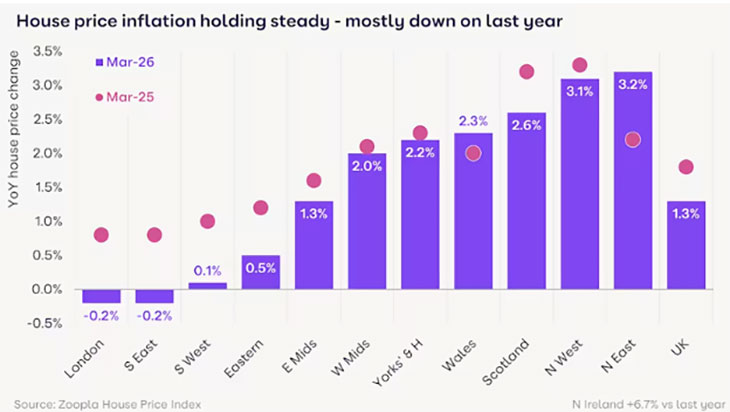
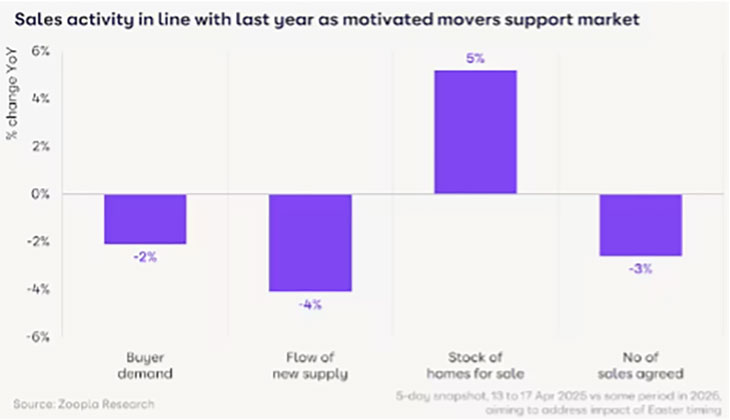
Add to this surveys such as the GFK index Nationwide refers to which are reporting consumers feeling more pessimistic about the economic outlook and their finances and it’s not a surprise that buyers in particular are feeling that there is ‘no hurry’ to move. If there is plenty of property stock available and prices aren’t racing forward, why should movers rush?
Meanwhile for those sellers that need to move, as long as they are pricing fairly, it does appear the market is still moving, albeit slower than last year.
What’s hugely important during this uncertain time is that local agents report what’s happening with local media – and buyers and sellers learn to trust this information rather than the relatively useless information provided at a national level!
