Plan ahead – floorplans sell houses
Andrea Kirkby asks, should floorplans be a permanent part of your marketing mix?
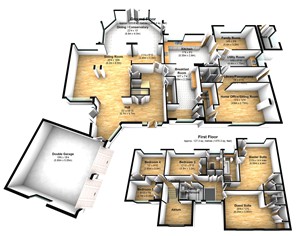 Once upon a time, floorplans were the exception rather than the rule. The few agents who did include plans could sell themselves as providing a distinctively different service, and win instructions on the back of it. But now well over 50 per cent of properties are marketed with a floorplan, according to surveys by Metropix, and it’s edging up a couple of per cent every quarter; even rental properties are adopting floorplans fast, though from a low base (right now, it’s only 15 per cent). That makes it more difficult to differentiate an agency just through the floorplan. And EPCs are compulsory – so how different can an agent be?
Alan Bookless, Director of Floorplanz Ltd, says it’s impossible to do anything with an EPC. “An EPC is an EPC, it’s either right or it’s wrong,” he says. And Ray Dowling, of Dowling Jones Design, agrees with him. “It’s just a compliance product. There’s no way of tarting it up. It is what it is.”
That makes cost and time the most important factors – getting the property on the market as quickly as possible, for the lowest price. And when the client is paying for the EPC, even the price isn’t that important; it’s speed to market that matters, particularly in today’s market when there’s a dearth of inventory.
PIMP YOUR FLOORPLAN

But things are very different when it comes to floorplans. The concept is simple, but as Ray Dowling says, “It’s no use reinventing the wheel, but the way you present and brand them can make a difference.”
For instance the typeface can be changed to fit the agent’s other marketing materials; different colours can be used, or white on a coloured background; even such small details as a different compass rose can be telling. Ben Robinson at ETSOS says, “All our agents have their own preference, from black and white with just the room names on, to 3D with measurements, and all the fixed items shown as well. Colours, shadows, all the way up to 3D, and a watermark as well – all these are possibilities, and of course the watermarking prevents the floorplan being pinched by another agent.”
He says half of ETSOS’ volume is 3D now, a big change from just a year ago; it’s clearly taking off with their clients.
But ETSOS may not be typical. James Davis, at software provider The Mobile Agent, says his market research suggests 65 per cent of properties have floorplans, and 96 per cent of those are plain old 2D. He says the problem is that 3D doesn’t look exactly like the real house, any more than 2D does – it’s just a schematic – but vendors often expect it to. But he expects it to increase its share in future, particularly as software companies give agents more options to show fittings and finishes.
And some still find their very creation time consuming; Paul Jaszynski at Zentuvo says, “We understand that it can be difficult for agents to find time to draw up an accurate floorplan. That is why Zentuvo is happy to offer a full drawing and productions service. 90 per cent of our clients use our standard 2D Floorplans however, we have a select few who also offer our 3D and home designer floorplans.”
Adoption appears to be patchy. Brian Farrell of Metropix says agents’ use of floorplans tends to vary town by town.
“In Reading everybody uses floorplans, in Maidenhead it’s only about 50 per cent.”
If the market leader adopts 3D, other agents quickly follow; the same will be true with other refinements and new products, he believes.
There are some fascinating products on the horizon. The interactive floorplan, for instance, is no more difficult to create than the basic floorplan, but allows viewers to see photos of each room by clicking on hotspots. Ben Robinson likes this; it expands the floorplan’s usability and leaves the user in control of the experience, unlike a walkthrough, which dictates the sequence they must follow. But, he says, “It’s fairly new, and still accounts for less than 10 per cent of our work.”
But again, adoption is patchy. Alan Bookless says, “Though I like them myself, we don’t get any call for them; maybe our end of the market think they’re a bit gimmicky.”
AUGMENT YOUR REALITY
Augmented Reality is another interesting new technology. Metropix’s Space Planner now allows prospective purchasers or tenants to drop their own furnishings into the floorplan, as long as it’s hosted on Metropix’s server. (Ikea has a similar functionality on its website.) Brian Farrell says augmented reality will be particularly useful for developers and agents selling off-plan, “and you’re talking about sites that are worth many millions of pounds to the developers, so the cost is not an issue” as it would be with ordinary resale properties.

It’s clear that the bar for really surprising and delighting clients has got higher. Farrell reckons that 45 per cent of plans are upgraded now in one way or another, a vast increase on a couple of years ago.
That’s all extra work for the estate agent. No wonder many agents want to outsource it, and there’s an increasingly large ecosystem of firms to help them do so. While there are still a good number of independent energy assessors, many firms now offer both services as part of a package.
Outsourcing is still a minority choice, according to Brian Farrell, who estimates only 15 per cent of the floorplans on Rightmove are created by a domestic energy assessor or floorplan provider. But, he says, that number has been creeping up, from less than 10 per cent a couple of years ago.
The availability of purpose-built software like Metropix and The Mobile Agent has helped agents cut down the work involved. “An agent can do it themselves with Metropix,” he says, “because it’s quick, intuitive, easy, and a six year old could pick it up with no training.” Metropix’s Draw a Floorplan competition was won by an estate agent from Findahome in just 2 minutes 48 seconds, showing how quickly it can be done, and Metropix’s database of existing floorplans can be used as templates, making the job even easier.
LOOK TO THE FUTURE
Things could be getting even easier. Brian Farrell believes that, “eventually you’ll just walk into a room and the device will scan and draw the room automatically.” And, he says, software will build the floorplan into an end-to-end instruction taking process, so that everything from client signup to portals feed can be managed on the iPad. “All this software is already out there,” he claims, “but nobody’s yet put it in one place.”
However speedy floorplans are, though, most agents have cut their staff to the bone, and now the market has recovered, they’re busy. As Ben Robinson says, “Anything that takes them away from sales is a waste of staff time.” Besides, the floorplan and EPC can be combined, a highly practical route for an outsourcer since a plan has to be drawn as part of the EPC. The added cost of producing a presentation quality floorplan is only £15-25, if it’s combined with the EPC, making a dual outsource highly competitive.
James Davis says the fit between EPCs and floorplans is natural. About half The Mobile Agent’s customers are energy assessors, and the other half estate agents, though they want different things from the software; agents want a good looking plan, energy assessors want heat loss perimeter calculations. “You don’t see the floorplan in the final EPC,” he says, “but the fact that the plan has helped you do the calculations really speeds you up”.
Besides, few agents are large enough to employ multiple trained energy assessors. Where one member of staff takes on EPCs as well as sales, there’s obviously a problem when they are on holiday, or a sudden rush of new instructions happens. And speed is important – the property can’t be marketed till the EPC’s been done. “Once you’ve got them through the front door turnaround is quick,” Brian Farrell says, “but you need that appointment as soon as possible,” and an outsourcer’s larger network of energy assessors can help that happen.
Using an outsourcer cuts down the agent’s workload. ETSOS, for instance, even collects the fee for the EPC, rebating any administration charges to the agent; and as well as doing EPCs and floorplans, it can offer ‘Complianceinabox,’meeting all regulatory requirements and ironically providing pretty much what HIPs were intended to deliver. Dowling Jones Design can also deliver more than just bare components; Ray Dowling says “I hate the term, but we really are a one stop shop – we get involved in everything from floorplans and EPCs to branding, photography, brochures and print,” provided as a single package. Floorplanz, too, finds it’s increasing asked to provide a package of services; Alan Bookless says “most of our jobs now involve two if not three services,” including photography and printing as well as EPCs and floorplans.
Perhaps the biggest change in the market, though, is the move towards up-front fees. EPCs were the first time that estate agents asked their clients for an upfront fee, and Brian Farrell says that’s changed things for good. Now, more and more agents are selling enhanced marketing packages, and that means some of the services that previously might have been too expensive for an average property are being more widely used. That’s sure to raise clients’ expectations – and put the squeeze on those agents who are still not using floorplans as part of their service.
CONTACTS:
Dowling Jones Design: www.dowlingjonesdesign.com
ETSOS: www.etsos.co.uk
Floorplanz: www.floorplanz.co.uk
Metropix: www.metropix.com
The Mobile Agent: www.themobileagent.co.uk
Zentuvo: www.zentuvo.co.uk