BLOG: What next for the property market as the economy falters?
Leading London estate agent wonders what it would take to re-ignite the capital's housing market given the UK's national economic woes.
 There is a growing sense, shared quietly in boardrooms and rather less quietly over kitchen tables, that the UK has lost a degree of economic direction.
Whatever one’s political persuasion, it is hard to ignore that many of the key indicators, growth, productivity, business confidence and youth employment, are heading the wrong way, and doing so, with uncomfortable speed.
‘Feel-bad factor’
What has emerged is a pervasive ‘feel-bad factor’, a drag on sentiment that is proving just as influential as any hard data. Layer on top of that the prospect of persistent inflation and higher interest rates, and it is little wonder that markets, including residential property, have taken a cautious step back.
At the upper end, this is clearly visible. Property transaction volumes have thinned, driven in a large part by recent tax changes and a fog of uncertainty. Values have adjusted accordingly, by as much as 20%-25% in parts of the prime market in central London, while the more domestic £1m to £3million sector has softened more modestly, by around 10%.
No flood
And yet the long-anticipated flood of distressed selling has not materialised; there is no avalanche of supply. No panic. No capitulation.
Instead, what we are seeing is a market that is illiquid, yes, but also surprisingly well supported. Many vendors are under little pressure to sell. Stock remains constrained. And that imbalance is placing a floor beneath current values.
So, while the mood music may be gloomy, the structural foundations are rather more resilient than the headlines would suggest.
Sunny uplands?
Which brings us to the more optimistic question: where are the ‘sunny uplands’? The answer, in large part, lies in policy.
At some point over the next electoral cycle, a more market-friendly administration, whether Conservative, Reform, or some hybrid thereof, may look to recalibrate the current tax landscape. And if that happens, two policy levers stand out for me.
Stamp Duty
Since its overhaul under George Osborne, in 2014, Stamp Duty Land Tax (SDLT) has acted less like a revenue raising device and more like a tourniquet, restricting flow, suppressing mobility, and dampening transaction volumes across the board.
Its reform, or partial rollback, would not just stimulate the housing market; it would release capital into the wider economy with meaningful downstream effects on spending and tax receipts.
It is one of the most obvious pieces of ‘low-hanging fruit’ available to any incoming government looking for a quick economic win, blissfully absent of left-wing political dogma.
Non-doms
Its recent removal has had a pronounced and predictable impact on the upper tiers of the London market. International buyers have stepped back, some have left altogether, we are told this amounts to some 16,000 people, and liquidity has suffered.
Reintroduce a competitive framework, perhaps via a flat annual levy of £250,000, and the effect could be swift and dramatic. Capital, particularly global capital, is highly mobile. It does not disappear, it simply waits for a more hospitable environment.
And London, for all its current challenges, remains exactly that, when conditions are right.
Should these two levers be pulled in tandem, the consequences for the property market could be significant. Sterling remains relatively weak in historical terms, and when combined with price adjustments across prime London, assets are beginning to look, whisper it, good value on a global basis.
Lip-smacking
For international buyers, that combination has historically proven irresistible and very tempting. A ‘lip smackingly’ delicious meal if you will.
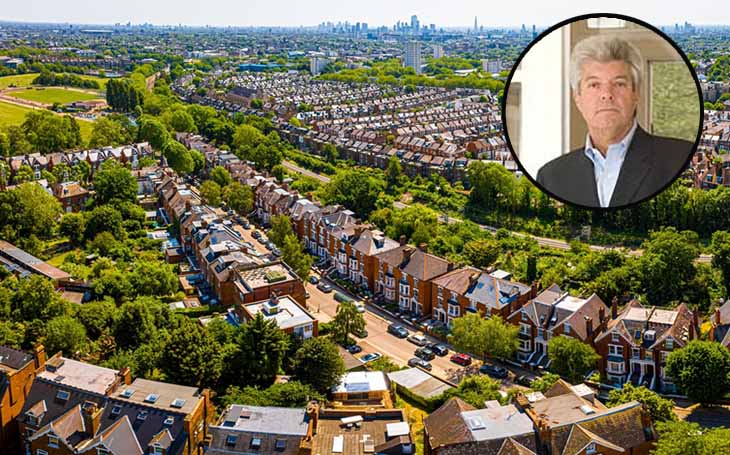
North West London, in particular, stands to benefit disproportionately. Sitting just beyond the traditional prime property core, it offers relative value while still operating within the gravitational pull of global demand. When confidence returns, as it invariably does, this is the kind of market that sees an accelerated re-rating.
Flickers of resilience
Even now, there are flickers of resilience. The core domestic market continues to tick along in an orderly fashion, and recent activity in the £5 to £10 million bracket has, if anything, exceeded expectations given the prevailing narrative.
So no, all is not lost, far from it.
Markets move in cycles, sentiment overshoots, and policy, for better or worse, rarely stands still. Today’s stagnation may feel uncomfortable, but it also creates the conditions from which the next phase of growth can emerge.
Trevor Abrahmsohn is CEO of Glentree Estates