UK rents continue to rise
Rents increase above inflation, led by gains in Greater London.

 Rents on new tenancies rose across most parts of the UK over the three months to February, led by gains in the capital, fresh figures show.
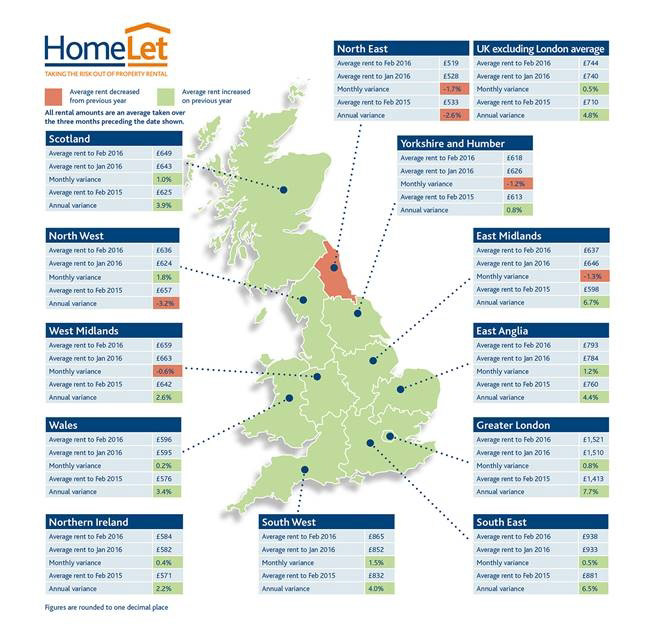
The latest data from the HomeLet Rental Index reveals that the cost of a new tenancy in the private rentals market in the UK, excluding Greater London, rose by 4.8 per cent in the three months to February 2016 compared with the corresponding period 12 months earlier.
Although the latest figures represent a fall from the 5.5 per cent rise witnessed over the three months to January, rents on new tenancies continue to rise at a much faster rate than inflation in most parts of the country.
According to the Index, rental price growth was led by Greater London, where rents rose by 7.7 per cent year-on-year, followed by gains of 6.7 per cent in the East Midlands and 6.5 per cent in the South East of England. At the other end of the other end of the spectrum, rents fell by 2.6 per cent in the North East and by 3.2 per cent in the North West.
The increase takes the average rent for new tenancies in the UK, excluding Greater London, to £744 per month. In Greater London it is £1,521 but the rate of growth remains below the double digit rises witnessed in 2015.
The Index reveals that rents on new tenancies increased in 10 out of 12 regions in the UK on an annual basis over the three months to February 2016. The only regions not to record growth were the North West of England, where rents dropped by 3.2 per cent from £657 per month last year to £636 per month, and the North East of England, where rents now stand at an average of £519 per month, down 2.6 per cent year-on-on-year.
 “We’re continuing to see the effect of the imbalance between demand and supply in the private rental market,” said Martin Totty (left), Chief Executive of Barbon Insurance Group, HomeLet’s parent company.
“Average rents are still rising and while we are not seeing the double digit increases recorded in some areas of the country during the summer of last year, the cost of a new tenancy continues to rise more quickly than general inflation,” he added.
HomeLet’s research also reveals that fewer single occupants are now renting properties, with the number of new tenancies signed by a single tenant having dropped from 67 per cent of new tenancies in 2008 to just 33 per cent today.
By contrast, the proportion of new tenancies signed by two tenants rose from 28 per cent to 52 per cent over the same period. New tenancies signed by three or more tenants have risen from 5 per cent to 15 per cent of the market.
Totty continued, “Our data on the number of tenants in each property gives a fascinating insight into the changing nature of the private rental market. Landlords are letting out homes to many more families, with rental property representing an increasingly important alternative to owner occupation; we’re also seeing people manage with higher rents by meeting the costs as joint tenants.”