Is the property market surviving the US-Iran war better than expected?
Six months into the US-Iran conflict, economic growth and housing activity have held up better than many feared, writes Kate Faulkner.
 Sadly, the US-Iran conflict didn’t last the 4-5 weeks that President Trump predicted at the start of Operation Epic Fury. We are now six months into the war – epic fury indeed.
Since this time we’ve had a whole host of declarations suggesting it would be over in days or weeks, but as yet, nothing has been agreed and the movement of vital shipping – including much needed oil – has failed to materialise.
The predictions for the impact were pretty bad at the time, even with a short war. According to the Resolution Foundation: “Sustained conflict in the Middle East could deliver an £11 billion hit to UK family finances” in the form of higher mortgage rates, utility bills and costs at the pump and of course for business, it could reduce UK output, jobs and put pressure on everyone’s incomes.
However, so far, the good news is it hasn’t actually hit as much as expected. Mortgages are more expensive than they were at the start of the year, but not due to the expected rise in interest rates which have remained the same.
The economy continued to grow at +0.4% in the quarter to June 2026 and although this was lower than the 0.6% growth in the first quarter.”
The latest GDP figures show that thanks to the sunshine and the football, the economy continued to grow at +0.4% in the quarter to June 2026 and although this was lower than the 0.6% growth in the first quarter, it does suggest that so far, we’ve weathered the storm quite well.
Whether this will continue though is a in a bit of doubt with the recent rise in inflation, mostly caused by the 13% increase in utility bills in July, which are likely to be felt as we move into the Winter rather than have a major impact just now.
And from a property perspective, although things aren’t as good as last year, despite all the issues that buyers and sellers have had to cope with, property transactions, if not prices are holding pretty well.
And on the price front, if you are in the Midlands or the North, not in the Prime Market and selling mostly houses as opposed to flats, then prices are still mostly rising. Unfortunately if you are in Aberdeen or work in the Prime Market and are down South, mostly selling flats, you will feel like you are working in a very difficult market indeed.
But for both markets, the one thing we have is mostly a lot of stock – in fact Rightmove estimate we have more properties for sale than have seen in 12 years and Zoopla estimate that there are 5% more properties to choose from, on average, than we’ve saw last year.
Overall though, so far, both the economy and the property market has yet, for most, held up much better than expected.
Impact on key property market statistics
Considering the economic and geopolitical backdrop, we did all expect I think for the market to be tough this year, but instead the latest indices suggest the market has been subdued and held back rather than suffering a major downturn.
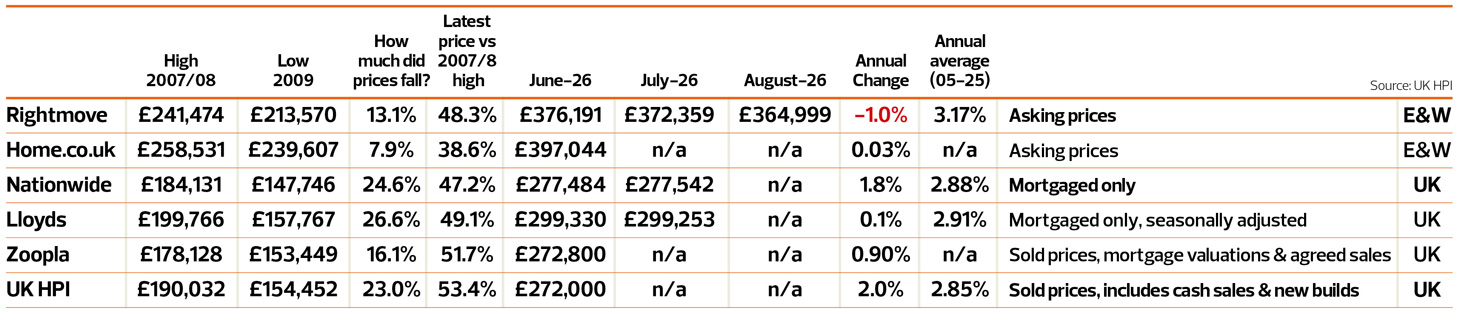
Nationally, price growth is weak: Nationwide reports annual growth of 1.8%, Lloyds just 0.1% and Zoopla 0.9%, while Rightmove recorded a larger-than-usual 2% fall in asking prices in August. However, this masks very different markets around the country, with prices continuing to rise more strongly in parts of the North while remaining flat or falling across much of southern England.
The good news from the latest indices is that although there is more stock on the market and sellers (and agents) have to price realistically, buyers haven’t disappeared at all. In fact, Zoopla’s data shows that searches for homes are now 7% higher than a year ago, although sales agreed remain 6% lower, while Rightmove says buyer demand has increased by 5% since Andy Burnham became Prime Minister.
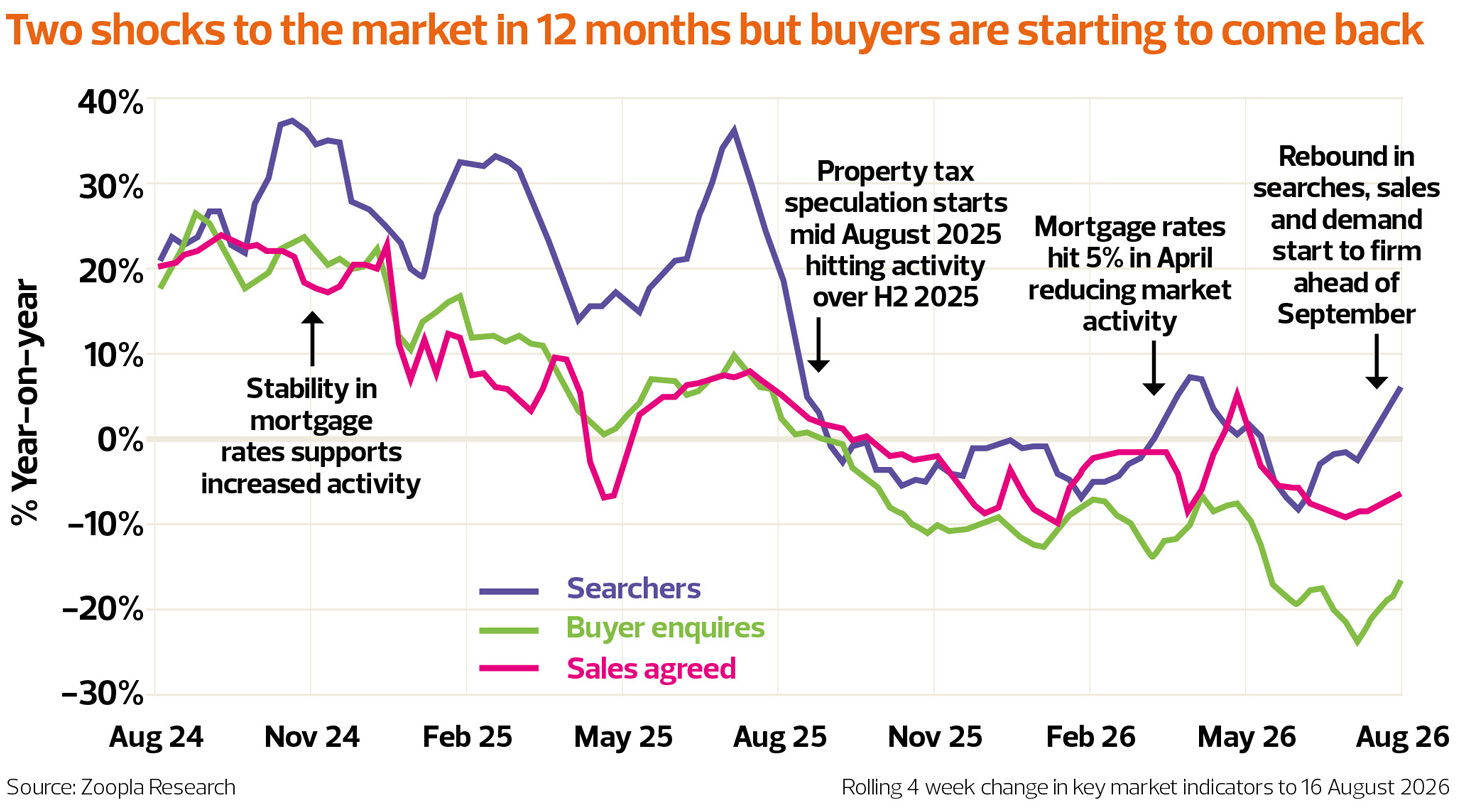
The national price averages from the indices show they are either the same or a little less, which is good news for buyers that seeing their affordability squeezed with Zoopla reporting a 9% reduction in buying power since January 2026: “Average five-year fixed mortgage rates have risen from below 4% in January to around 4.8% today. A buyer who could afford a £200,000 mortgage at the start of the year can now borrow around £182,000 for the same monthly repayment – a 9% reduction in buying power.”